Beyond 2030: Why the UN Sustainable Development Goals Are Everyone’s Responsibility
From global commitments to individual action, the Sustainable Development Goals remind us that the future is not something we inherit—it is something we collectively create.
In September 2015, the nations of the world came together around an ambitious idea: that economic progress, human dignity and the health of our planet should not be competing priorities.
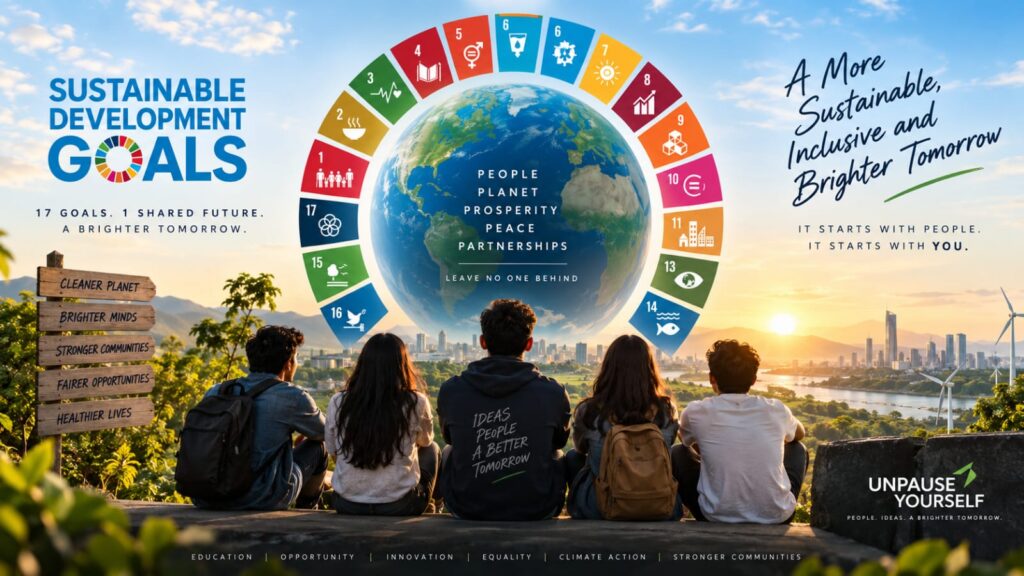
Through the 2030 Agenda for Sustainable Development, United Nations Member States adopted 17 Sustainable Development Goals (SDGs) and 169 associated targets, a shared framework designed to address some of humanity’s most consequential challenges, from poverty and hunger to education, inequality, climate change, innovation, employment, peace and global cooperation.
At the heart of this agenda is a simple but powerful commitment:
Leave no one behind.
Yet as 2030 draws closer, perhaps the most important question is no longer “What are the Sustainable Development Goals?”
It is:
“What role do each of us play in achieving them?”
The 17 Goals: One Shared Future
The Sustainable Development Goals encompass virtually every dimension of sustainable human progress:
SDG 1: No Poverty
SDG 2: Zero Hunger
SDG 3: Good Health and Well-Being
SDG 4: Quality Education
SDG 5: Gender Equality
SDG 6: Clean Water and Sanitation
SDG 7: Affordable and Clean Energy
SDG 8: Decent Work and Economic Growth
SDG 9: Industry, Innovation and Infrastructure
SDG 10: Reduced Inequalities
SDG 11: Sustainable Cities and Communities
SDG 12: Responsible Consumption and Production
SDG 13: Climate Action
SDG 14: Life Below Water
SDG 15: Life on Land
SDG 16: Peace, Justice and Strong Institutions
SDG 17: Partnerships for the Goals.
These are not 17 isolated ambitions.
Education influences employment. Employment affects poverty. Innovation can improve healthcare, agriculture and climate resilience. Strong institutions enable development, while partnerships allow ideas, technology and resources to cross borders.
The United Nations therefore describes the Goals as interconnected and emphasizes that sustainable development requires the integration of economic growth, social well-being and environmental protection.
That interconnectedness may be the most important lesson of the SDG framework: progress cannot exist permanently in isolation.
2030 Is Getting Closer
There is also a difficult reality behind the optimism.
According to the UN’s 2025 assessment, only 35% of SDG targets for which sufficient trend data were available were on track or showing moderate progress. Nearly half were demonstrating insufficient progress, while 18% had regressed below their 2015 baseline levels.
Conflicts, climate pressures, inequality, economic uncertainty and financing constraints have complicated the journey towards 2030.
But these figures should not become an argument for pessimism.
They should become an argument for acceleration.
The UN itself notes that meaningful advances in individual countries demonstrate that faster progress remains possible when effective policies, institutions and partnerships come together.
The remaining years therefore represent not merely a countdown, but a window for action.
SDGs Are Not Only a Government Agenda
One of the biggest misconceptions surrounding sustainable development is that it belongs primarily to governments, diplomats and international organizations.
Governments certainly have a fundamental role. But transformation of this scale cannot happen through public policy alone.
It requires educators who expand opportunity.
It requires entrepreneurs who build responsibly.
It requires businesses that look beyond quarterly returns.
It requires scientists and innovators who solve problems that matter.
It requires institutions that remain accountable.
And it requires young people willing to participate rather than merely observe.
A teacher enabling a first-generation learner contributes to the spirit of SDG 4.
An entrepreneur creating dignified employment advances the principles behind SDG 8.
A technology company developing accessible solutions can contribute to SDG 9 and SDG 10.
A business reducing waste participates in SDG 12.
Communities protecting local ecosystems advance SDGs 13 and 15.
And whenever governments, businesses, universities, civil society and individuals collaborate meaningfully, they bring SDG 17 to life.
The SDGs become powerful when they stop being numbers on a document and start becoming choices in everyday life.
Education: Where Sustainable Development Begins
Among the Goals, SDG 4—Quality Education—has a particularly powerful multiplier effect.
Education does more than prepare someone for employment.
It develops agency.
A well-educated young person is better equipped to understand health, participate in economic activity, adopt technology, question misinformation, make informed decisions and contribute meaningfully to society.
But education itself is changing.
In an era shaped by artificial intelligence, automation and rapidly evolving industries, access to schooling alone is not enough. Education increasingly needs to connect knowledge with skills, skills with opportunities and opportunities with purpose.
The future belongs not merely to those who possess degrees, but to those who continue learning.
That makes lifelong learning not simply a professional advantage—it increasingly becomes an important component of sustainable and inclusive development.
Entrepreneurship and Decent Work
Sustainable development also requires economic opportunity.
SDG 8 calls for inclusive and sustainable economic growth, productive employment and decent work, while SDG 9 focuses on resilient infrastructure, sustainable industrialization and innovation.
Together, they raise an important question about entrepreneurship:
What kind of businesses should the next generation build?
The enterprises of tomorrow cannot measure success exclusively through valuation and revenue.
The strongest businesses of the future can create value on multiple levels—commercially, socially and environmentally.
Imagine entrepreneurship where profitability and purpose are not opponents.
Where innovation creates accessibility.
Where technology expands opportunity instead of deepening exclusion.
Where employment provides dignity rather than simply labour.
And where sustainability becomes part of business architecture rather than an afterthought.
That is where entrepreneurship begins to move from merely creating companies to creating capacity for society.
Technology and AI: Accelerators With Responsibility
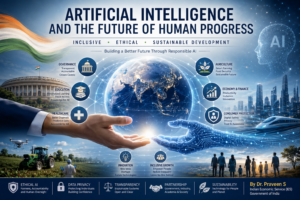
Artificial intelligence represents one of the most consequential technological developments of our generation.
Its potential contribution to development is enormous—from healthcare and education to agriculture, climate modelling, financial inclusion and public administration.
But technology is never automatically inclusive.
Without thoughtful deployment, the same technologies that create opportunities can deepen digital divides, displace certain forms of work or reinforce existing inequalities.
The challenge, therefore, is not simply to innovate faster.
It is to innovate responsibly.
Our measure of technological progress should not only be what machines become capable of doing, but how effectively technology expands human capability.
Innovation acquires its greatest meaning when progress reaches people who previously stood outside its boundaries.
From Global Goals to Local Action
The SDGs are global, but their success is ultimately local.
Climate action becomes real when a city improves waste management or transportation.
Quality education becomes real inside a classroom.
Gender equality becomes real inside homes, workplaces and institutions.
Decent work becomes real when an individual receives a genuine opportunity.
Responsible consumption becomes real when consumers and businesses reconsider what they buy, produce and discard.
Global transformation is therefore the cumulative outcome of millions of local decisions.
And this is precisely why individuals matter.
India’s Generation of Opportunity
For a young and ambitious country such as India, the sustainable-development conversation intersects naturally with education, entrepreneurship, digital transformation, skilling, innovation, employment and inclusive growth.
The young people entering classrooms, universities, laboratories, startups, businesses, public institutions and social organizations today will be among those shaping the India of 2047.
Their challenge is larger than finding careers.
It is to build institutions, technologies, enterprises and communities capable of creating opportunity for others.
A generation that combines skills with empathy, ambition with responsibility and innovation with inclusion can transform sustainable development from an international framework into a lived reality.
Sustainable Development Is Ultimately About Human Dignity
Behind the terminology, statistics and colourful SDG icons lies something profoundly human.
A child deserves education.
A family deserves access to food and clean water.
A worker deserves dignity.
A woman deserves equal opportunity.
An entrepreneur deserves an ecosystem in which responsible innovation can flourish.
A community deserves safety and justice.
And future generations deserve a planet capable of sustaining their aspirations.
Sustainable development is therefore not simply about meeting 169 targets.
It is about expanding the possibility of a dignified life.
The Unpause Perspective
At Unpause Yourself, we believe meaningful change often begins with a decision to move—from awareness to action, from hesitation to participation, and from individual ambition to collective contribution.
The Sustainable Development Goals provide the world with a common language.
But frameworks alone do not transform societies.
People do.
Every educator who opens a door, every entrepreneur who creates responsible employment, every innovator who solves a meaningful problem, every institution that chooses accountability and every citizen who participates constructively becomes part of the larger development story.
2030 is a milestone.
But sustainable development cannot have an expiry date.
The real objective should be to build a culture in which sustainability, dignity, inclusion and responsibility become embedded in how we learn, work, innovate and lead.
The question, therefore, is not whether one individual can achieve all 17 Sustainable Development Goals.
The better question is:
Which goal can you begin contributing to today?
Because changing the world rarely begins with changing everything.
It begins when someone decides to unpause.
About The Author