Success After 35
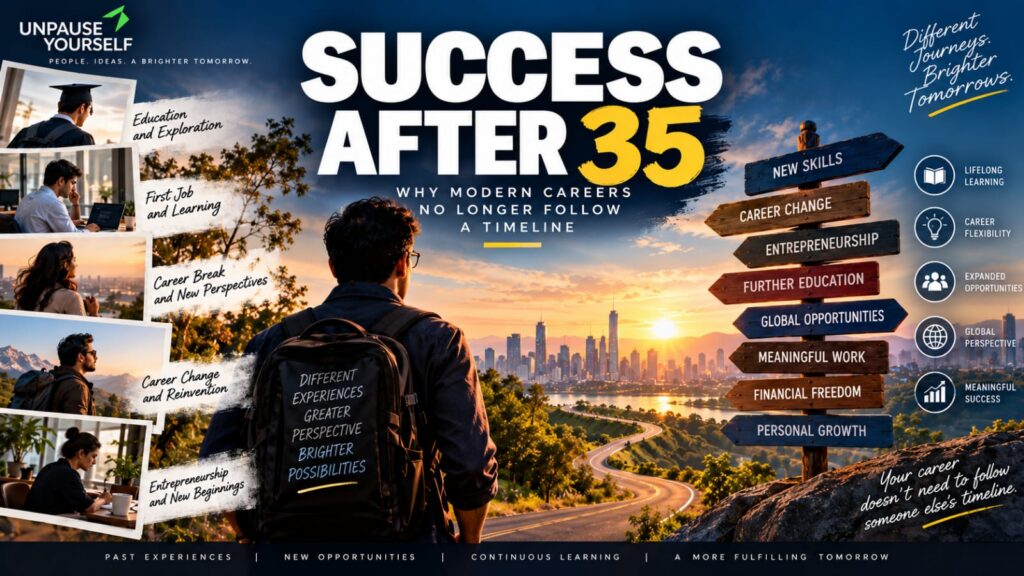
Why Modern Careers No Longer Follow a Timeline
At 22, you are expected to know what you want. At 25, you should supposedly be settled. At 30, established. By 35, successful.
But who created this timeline?
For generations, we have inherited an unwritten calendar for life.
Complete your education.
Find a job.
Build a career.
Get promoted.
Become financially secure.
And somewhere along the way, preferably before a socially acceptable age, arrive at something called success.
The problem is that modern life increasingly refuses to follow this script.
People change industries at 38.
Start businesses at 42.
Return to university at 47.
Write their first book at 50.
Learn technology at 55.
Begin consulting after retirement.
Build second—and sometimes third—careers.
The traditional career ladder is slowly being replaced by something far more interesting:
The career journey.
And journeys rarely move in straight lines.
The Myth of Being “Late”
One of the most damaging words in modern career conversations is late.
“I am late in my career.”
“I should have achieved more by now.”
“My friends are already ahead.”
“I should have started this ten years ago.”
But late compared with whom?
Careers are not standardized examinations in which everyone receives the same question paper and the clock starts simultaneously.
One person enters the workforce at 21.
Another spends years preparing for competitive examinations.
Someone else cares for family.
Another experiences financial difficulty.
Someone moves countries.
Someone builds a business that fails.
Someone spends a decade in one profession before realizing it was never the right fit.
Another discovers what they genuinely want only after experiencing what they do not want.
These lives cannot reasonably be measured using the same timeline.
Different starting points create different journeys.
Why 35 Can Be a Beginning, Not a Deadline
There is something interesting about reaching your mid-thirties and beyond.
You may have something that your younger self did not:
context.
You understand workplaces better.
You have experienced difficult people.
You may have made financial mistakes.
You know what rejection feels like.
You have probably discovered some of your strengths—and some limitations.
You understand that impressive titles do not automatically create meaningful lives.
Perhaps most importantly, you begin understanding yourself.
At 22, ambition can be enormous but direction uncertain.
At 35, ambition may be accompanied by something equally valuable:
judgement.
That combination can be powerful.
Experience Compounds
We often discuss compound interest in finance.
But careers compound too.
A decade spent working does not produce only ten years of experience.
It can produce:
relationships,
industry knowledge,
communication ability,
professional judgement,
financial understanding,
resilience,
credibility,
and pattern recognition.
Even experiences that initially appear unrelated can eventually combine.
Someone who worked in banking, studied technology and later entered entrepreneurship may understand business differently from someone who followed only one path.
A teacher who becomes a founder carries an understanding of communication.
An engineer who enters public policy carries technical reasoning.
A corporate professional who becomes a writer brings years of human observation.
The modern economy increasingly rewards people capable of connecting disciplines.
Your past therefore does not always need to be discarded when you reinvent yourself.
Sometimes reinvention means recombining what you already know.
Career Breaks Are Not Career Deaths
Traditional résumés taught us to fear gaps.
Every year was supposed to contain a designation.
Every transition required explanation.
But real lives contain interruptions.
People step away because of:
family responsibilities,
health circumstances,
competitive examinations,
entrepreneurship,
education,
relocation,
economic downturns,
personal transitions,
or simply the need to reconsider direction.
A career break can create challenges. It can affect income, professional networks and confidence.
It should not be romanticized.
But neither should it automatically be interpreted as the end of professional relevance.
The important question is often not:
“Why did you stop?”
but:
“What did you do with what came next?”
A gap can remain a gap.
Or it can become a chapter.
Technology Has Changed the Cost of Starting Again
Previous generations often faced enormous barriers to professional reinvention.
Learning something new could require enrolling in a formal institution.
Building a business required significant infrastructure.
Publishing required gatekeepers.
Finding international clients was difficult.
Professional networking depended heavily on geography.
Today, many of those barriers have weakened.
Someone sitting in a small city can learn from a university thousands of kilometres away.
A professional can acquire new technical skills online.
An entrepreneur can build a digital business with relatively modest initial infrastructure.
A consultant can work internationally.
A writer can publish directly.
A professional can build a network across continents.
Artificial intelligence has further reduced the cost of accessing information and experimenting with new capabilities.
Technology has not eliminated inequality or guaranteed success.
But it has expanded the number of possible entry points.
And that matters enormously for people beginning again.
The Rise of the Second Career
The idea that one qualification should determine forty years of professional identity is becoming increasingly difficult to sustain.
Industries change.
Technologies evolve.
Organizations disappear.
Entire job categories transform.
People themselves change.
The person you were at 23 does not necessarily have the same interests, responsibilities or ambitions at 38.
Why should one decision made in youth permanently determine professional identity?
The future may increasingly belong to people comfortable with multiple professional chapters.
Employee.
Entrepreneur.
Consultant.
Teacher.
Creator.
Investor.
Advisor.
Researcher.
Writer.
These identities do not always have to compete.
Sometimes they can coexist.
The modern career may become less like a ladder and more like a portfolio.
Starting Later Can Have Advantages
Youth has extraordinary advantages.
Energy.
Time.
Freedom to experiment.
A longer runway for compounding.
But experience has advantages too.
Networks.
Perspective.
Domain knowledge.
Emotional maturity.
Financial understanding.
A clearer sense of priorities.
Starting at 40 is not the same as starting at 20.
That statement is neither positive nor negative.
It is simply true.
The resources are different.
The constraints are different.
The advantages are different.
Instead of wishing for someone else’s starting point, the more useful question is:
What advantages exist at my starting point?
That changes the conversation from regret to strategy.
Comparison Creates Artificial Deadlines
Social media has made professional comparison almost unavoidable.
At breakfast, you can discover that someone became a CEO.
By lunch, someone else has raised funding.
In the evening, another person announces a prestigious fellowship.
Before sleeping, you discover someone younger than you has accomplished something you have wanted for years.
What you rarely see is the complete context.
The family support.
The failed attempts.
The debt.
The connections.
The timing.
The sacrifices.
The uncertainty.
The years of preparation preceding the announcement.
We increasingly compare our complete lives with other people’s selected milestones.
That is an unreliable measurement system.
Someone else’s achievement can be evidence that something is possible.
It does not have to become evidence that you are behind.
Reinvention Still Requires Work
There is a danger in discussing late success too romantically.
It can create the impression that age itself eventually produces opportunity.
It does not.
Starting again at 35, 40 or 50 can be difficult.
Financial responsibilities may be greater.
Family obligations may limit risk.
Employers may prefer recent experience.
Technology can create learning curves.
Professional confidence may need rebuilding.
Networks may need refreshing.
Reinvention therefore requires more than inspiration.
It requires strategy.
Ask:
What skills from my previous career remain valuable?
Which skills have become outdated?
What does the market currently need?
What can I realistically learn in six months?
Who already works in the field I want to enter?
Can I experiment before making a complete transition?
What financial runway do I require?
How can I demonstrate capability rather than merely claim it?
The objective is not to leap blindly.
It is to transition intelligently.
Stop Asking, “Am I Too Old?”
A better set of questions might be:
Do I still have the capacity to learn?
Can I create value?
Am I willing to become a beginner again?
Can I tolerate temporary discomfort for longer-term change?
What can my previous experience contribute to my next chapter?
These questions are more useful because they focus on variables you can influence.
Age is a fact.
Capability can evolve.
Success Itself Changes With Age
Perhaps the most important transformation after 35 is not the career.
It is the definition of success.
At 22, success may mean salary.
At 28, designation.
At 35, independence.
At 42, meaningful work.
At 50, time.
At 60, contribution.
These are not universal stages.
But they illustrate something important:
Success is not a fixed destination.
Our definition of it evolves as we do.
The danger is spending decades pursuing a definition of success inherited from someone else.
A meaningful career requires occasionally asking:
What does success mean to me now?
Not ten years ago.
Not to society.
Not to LinkedIn.
Now.
You Are Not Starting From Zero
This may be the most important message for anyone beginning again.
When you change careers at 35 or 45, you are rarely starting from zero.
You carry conversations.
Mistakes.
Relationships.
Skills.
Failures.
Knowledge.
Professional instincts.
Life experience.
Perhaps you are starting at the beginning of a new field.
But you are not beginning again as a new human being.
There is an enormous difference.
The Unpause Perspective
At Unpause Yourself, the word unpause carries a simple philosophy.
Life can pause.
Careers can pause.
Ambition can pause.
Circumstances can interrupt plans.
Sometimes the pause lasts months.
Sometimes years.
But a pause does not automatically become a conclusion.
The world will continue telling us when things are supposed to happen.
Graduate by this age.
Earn this much by that age.
Reach this designation before another.
Build something before it is “too late.”
Perhaps we need a different measurement.
Instead of asking:
“Where should I have been by now?”
Ask:
“What can I build from where I am now?”
Because careers are becoming longer, industries are transforming faster, technology is creating new entry points, and human beings continue evolving throughout their lives.
Your first career does not have to be your final career.
Your first failure does not have to become your identity.
A pause does not have to become permanent.
And 35 is not an expiry date.
Neither is 40.
Neither is 50.
There is no universal age at which curiosity becomes irrelevant, learning becomes impossible or meaningful work becomes unavailable.
Modern careers no longer need to follow a perfect timeline.
They need something more important:
the courage to keep evolving.
And sometimes, the most consequential chapter begins after the point at which you once thought the story should already have been written.
About The Author