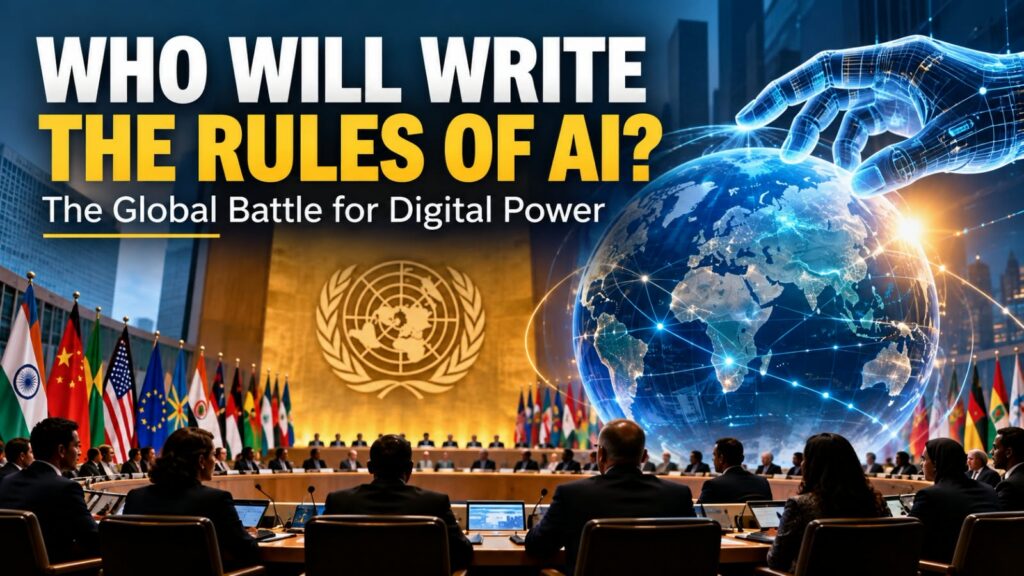
Who Will Write the Rules of AI? The Global Battle for Digital Power
October 2026 | World Affairs | Technology & Global Governance
Artificial Intelligence is no longer merely a technological revolution. It is rapidly becoming an issue of international diplomacy, economic power, development and global governance.
At the United Nations, a fundamental question has moved to the centre of the global conversation: Who should have a voice in deciding how AI is governed — and who will ultimately benefit from it?
On 30 September 2026, UN discussions focused on power, trust and inclusion in shaping the future of artificial intelligence. The debate reflects a broader concern: as AI develops at extraordinary speed, countries that lack computing infrastructure, investment, skills and institutional capacity risk becoming users of technologies and rules largely developed elsewhere.
The New Geography of Power
For much of modern history, geopolitical influence has been associated with military strength, natural resources, industrial capacity and financial power.
Artificial intelligence is adding another dimension.
Countries and companies with access to advanced computing infrastructure, sophisticated AI models, high-quality data, semiconductor supply chains and skilled researchers can potentially gain significant economic and strategic advantages.
The gap is already substantial.
A September 2026 report from the UN Secretary-General noted, citing World Bank figures, that high-income countries accounted for 77% of global co-location data-centre capacity as of June 2025, while low-income countries accounted for less than 0.1%.
The report also noted that although roughly half of UN Member States had national AI strategies in 2025, fewer than 20% of least-developed countries had one.
This raises a critical international question: Can AI become a genuinely global opportunity if the infrastructure needed to develop and govern it remains so unevenly distributed?
Developing Countries Want a Seat at the Table
The debate is therefore about much more than access to ChatGPT-style applications.
Developing economies need the ability to build technical expertise, establish regulatory institutions, develop digital infrastructure and participate meaningfully in international negotiations concerning AI.
The UN’s Global Digital Compact explicitly calls for the full and equal representation of all countries, particularly developing countries, in international AI governance. It also emphasizes capacity-building so developing countries can access, develop, use and govern AI themselves.
This matters because decisions being discussed today could influence how AI affects employment, education, privacy, intellectual property, cybersecurity, misinformation, human rights and economic development for decades.
A Global Fund for AI Capacity?
One significant proposal has now entered the discussion.
In September, the UN Secretary-General recommended advancing work toward a Global Fund for AI Capacity-Building designed to help address technological and institutional gaps facing developing countries.
The UN report suggests that an initial funding commitment of around $3 billion over two to four years could provide a starting point, although the structure and financing of such a fund remain matters for further consideration.
The underlying argument is straightforward: meaningful participation in AI governance requires more than representation at international meetings.
Countries also need computing resources, connectivity, energy infrastructure, reliable data, skilled professionals, legal frameworks and institutions capable of understanding and regulating increasingly sophisticated AI systems.
The UN’s Emerging AI Architecture
International AI governance is gradually becoming more structured.
The Global Digital Compact, adopted in 2024, established a framework for international digital cooperation. It called for an Independent International Scientific Panel on AI and a Global Dialogue on AI Governance.
The UN General Assembly subsequently established the Independent International Scientific Panel on Artificial Intelligence in August 2025. Its purpose is to provide independent scientific assessments of AI’s opportunities, impacts and risks so that international discussions can be informed by evidence.
These developments indicate that AI governance is moving from a largely technological discussion toward a permanent subject of international relations.
Why This Matters for India
For India, this transformation presents both opportunity and responsibility.
As a major digital economy and a prominent voice of the Global South, India sits at the intersection of several important debates: innovation versus regulation, technological sovereignty versus international cooperation, and rapid AI adoption versus inclusive development.
The larger question for countries such as India is not simply whether they will use AI, but whether they will help influence the principles and institutions governing it.
That distinction could become increasingly important as artificial intelligence affects global competitiveness, employment, education, public administration and national security.
AI Governance Is Becoming World Affairs
The twentieth century was shaped by institutions governing trade, finance, security and nuclear technology.
The twenty-first century may require equally consequential institutions for artificial intelligence.
The challenge is that AI is developing much faster than traditional international governance mechanisms.
Countries therefore face a difficult balance: rules must be strong enough to protect societies from genuine risks without becoming so restrictive that they prevent innovation or concentrate technological power even further.
There is unlikely to be a simple global consensus.
Different countries have different political systems, economic priorities, technological capabilities and approaches to privacy, security and individual rights.
But one principle is becoming increasingly difficult to ignore: technology that may transform billions of lives cannot be treated solely as a conversation among a handful of technologically powerful actors.
The emerging debate over AI is therefore ultimately a debate about power.
Who develops the technology?
Who owns the infrastructure?
Who establishes the standards?
Who receives its economic benefits?
And, perhaps most importantly, who gets a seat at the table when the rules are written?
The answers will help determine whether artificial intelligence narrows existing global inequalities — or creates an entirely new digital divide.
About The Author