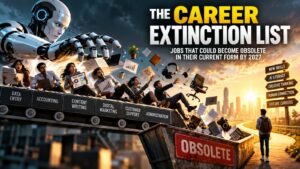
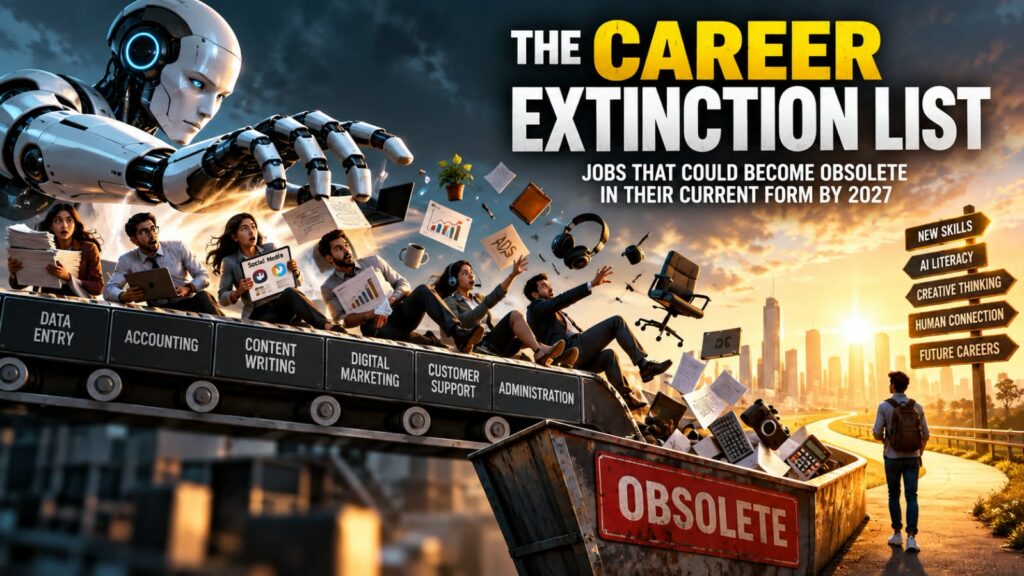
The Career Extinction List: Jobs That Could Become Obsolete in Their Current Form by 2027
Imagine spending three years learning a skill, earning a qualification and preparing for your first job only to discover that a machine can now perform a large part of that work in seconds.
This is no longer science fiction.
Artificial intelligence is moving from being a tool that assists workers to a technology capable of completing increasingly sophisticated pieces of knowledge work.
And that changes the career conversation completely.
For generations, young people were told:
Get qualified → Learn a profession → Find a job → Build experience → Create a career.
But in the age of AI, another question has to come before all four:
«Will businesses still need a human being to perform this task a year or two from now?»
That may become one of the defining career questions of 2027.
First, What Does “Obsolete” Actually Mean?
A profession does not need to disappear completely to become obsolete in its traditional form.
ATMs did not eliminate banks.
Email did not eliminate offices.
E-commerce did not eliminate retail.
Technology changes the number of people required, the skills employers pay for and the economic value of particular tasks.
AI could do exactly that—except considerably faster in some occupations.
The International Labour Organization’s global research found that roughly one in four workers worldwide is employed in an occupation with some degree of exposure to generative AI.
But there is an important distinction.
Most exposed occupations are expected to be transformed rather than completely eliminated.
The danger is therefore not necessarily:
“My profession will disappear.”
The more realistic danger may be:
“The company that previously required 20 people to perform this work may eventually require five people assisted by AI.”
That changes careers even if the job title survives.
30 Careers Entering the AI Disruption Zone
The following occupations should not be interpreted as jobs guaranteed to disappear in 2027.
They represent roles where routine, standardized or digitally executable tasks are increasingly vulnerable to automation, consolidation or AI augmentation.
- Data Entry Operators
Perhaps one of the clearest examples.
Reading information from documents, transferring it between systems, categorizing records and checking structured data are increasingly automatable.
A career built entirely around manually entering information into software faces an obvious challenge:
Software is learning to read the information itself.
- Typists
Typing was once a professional skill.
Today, voice recognition, automatic transcription and generative AI can transform speech into formatted text almost instantaneously.
Typing remains useful.
Typing itself is increasingly difficult to defend as a standalone career.
- Transcriptionists
Meetings, interviews, lectures and recordings can now be automatically transcribed, summarized and converted into action points.
Specialized legal and medical transcription may continue to require human verification.
Routine transcription faces far greater pressure.
- Administrative Assistants
Scheduling meetings.
Writing routine emails.
Preparing documents.
Organizing information.
Taking meeting notes.
Creating reminders.
Summarizing correspondence.
These are precisely the types of activities modern AI assistants are being designed to perform.
The administrative professional of the future may therefore need to become an operations coordinator and decision facilitator, rather than simply an administrative executor.
- Executive Secretarial Roles
Executive secretaries traditionally coordinate information around senior professionals.
AI increasingly handles calendars, documents, summaries, communications and information retrieval.
Human discretion, confidentiality and relationship management remain enormously valuable.
Routine coordination does not have the same protection.
- Bank Tellers
Banking has already undergone decades of automation.
Mobile banking, UPI-style instant payments, ATMs, digital KYC and automated customer service continue reducing the need for routine branch transactions.
The future bank employee will increasingly need to provide advisory, relationship or specialized financial services, not merely execute transactions.
- Cashiers
Self-checkout, QR payments, automated stores and digital commerce continue reducing dependence on conventional checkout processes.
Cashiers will not suddenly vanish worldwide.
But the direction of automation is difficult to ignore.
- Ticket Clerks
Airline tickets, railway reservations, cinemas, events, hotels and attractions increasingly operate through apps, QR codes and self-service systems.
When customers can search, purchase, modify and validate tickets themselves, the value of a person dedicated exclusively to issuing them declines.
- Bookkeeping Clerks
Routine bookkeeping involves categorizing transactions, reconciling records, generating invoices and maintaining financial data.
Modern accounting platforms increasingly automate these activities.
The accountant who understands taxation, compliance, financial strategy and business decisions remains valuable.
The person whose primary function is entering transactions faces much greater disruption.
- Routine Accounting-Support Roles
Accounting itself is not disappearing.
But the lower layers of repetitive accounting work are being automated.
The future belongs increasingly to professionals who can interpret financial information, identify risk, understand regulation and advise businesses.
- Basic Customer-Support Agents
“How can I reset my password?”
“Where is my order?”
“How do I cancel my subscription?”
“What is your refund policy?”
These are precisely the kinds of predictable conversations AI agents can increasingly handle.
Complex complaints, emotionally sensitive situations and high-value customer relationships remain different.
- Telemarketing Executives
Traditional telemarketing relies heavily on scripts, repetitive calls and predictable objections.
AI voice systems are becoming increasingly sophisticated.
The salesperson who builds relationships and negotiates complex transactions has considerable human value.
Reading a standardized script is far more exposed.
The Creative Professions Are Not Immune
For several years, people assumed AI would automate repetitive physical or clerical jobs while creative careers remained protected.
Generative AI challenged that assumption.
- Basic Content Writers
Businesses once required humans to produce every:
- blog,
- product description,
- email,
- social-media caption,
- FAQ,
- advertisement and
- landing-page draft.
AI can now produce enormous volumes of this material.
Original journalism, authoritative analysis, storytelling and genuine expertise retain value.
Generic writing is becoming a commodity.
- SEO Content Writers
The traditional formula—
keyword + 1,500 words + headings + keyword density = SEO article
—is becoming increasingly vulnerable.
Search itself is changing, while AI can generate optimized drafts rapidly.
Writers who possess genuine expertise, first-hand experience, research capability and authority will have a stronger position than writers producing interchangeable search-engine content.
- Basic Copywriters
AI can generate dozens of headlines, advertisements, product descriptions and calls to action almost instantly.
High-level persuasion and brand strategy remain valuable.
Routine copy production faces a different economic reality.
- Proofreaders
Grammar correction, spelling, sentence restructuring, consistency checking and basic editing can already be performed automatically.
Professional editors who understand meaning, narrative, facts and audience remain relevant.
Basic proofreading alone is becoming harder to build a career around.
- Routine Translators
AI translation has advanced enormously.
Human translators remain essential where cultural nuance, diplomacy, literature, legal precision or specialized interpretation matters.
But routine translation of everyday documents is increasingly automated.
- Basic Graphic Designers
Need ten Instagram creatives?
A presentation background?
An advertisement?
A product image?
A thumbnail?
Generative design systems increasingly allow non-designers to produce acceptable visuals themselves.
Exceptional designers will survive.
Average production work will become harder to monetize.
- Template-Based Presentation Designers
Creating standard slides from supplied information is increasingly automatable.
AI can structure information, generate layouts, suggest visuals and create presentations.
The future opportunity lies in information architecture, storytelling and executive communication, rather than merely arranging boxes on slides.
- Basic Video Editors
Automatic subtitles, silence removal, resizing, transitions, clipping, background replacement and even generative video creation are becoming increasingly automated.
Professional filmmaking and sophisticated editing remain different disciplines.
Routine social-media editing faces much greater disruption.
Office Knowledge Work Is Next
The next wave may be particularly significant because AI does not merely automate physical labour.
It automates language and information processing.
- Simple Research Assistants
Searching dozens of webpages, collecting basic information, summarizing documents and producing preliminary reports once required hours.
AI can increasingly perform the first layer of this research.
Researchers therefore need to move toward:
verification + methodology + interpretation + original investigation.
- Basic Market-Research Executives
Compiling competitors, summarizing industries, identifying trends and organizing public information are increasingly AI-assisted.
Human researchers remain essential for primary research, consumer psychology, interviews and strategic interpretation.
- Junior Reporting & Dashboard Roles
A professional who merely takes data from one system and converts it into another report is vulnerable.
AI-enabled analytics increasingly allows managers to ask questions directly of their data.
The valuable employee will not simply report:
“Sales declined 14%.”
They will explain:
“Here is why sales declined—and here is what we should do next.”
- Routine HR Screening Roles
Reading hundreds of CVs, matching keywords, scheduling interviews and sending standardized communication can increasingly be automated.
Human judgment remains essential in hiring.
Administrative recruitment processes are more vulnerable.
- Lead-Generation Operators
Finding company names, extracting public information, categorizing prospects and producing personalized outreach drafts can increasingly be automated.
Relationship-building remains human.
Database-building is much easier for machines.
Marketing Is Also Being Reconstructed
Digital marketing is important—but it is only one member of a much larger disruption list.
- Social-Media Scheduling Executives
A career based primarily on:
“Post this at 7 PM.”
“Schedule tomorrow’s Reel.”
“Write five captions.”
is increasingly vulnerable.
Platforms and AI systems can already automate large portions of these workflows.
- Routine Email-Marketing Operators
AI can draft subject lines, segment audiences, personalize messages and generate campaign variations.
The future marketer needs to understand the customer journey and commercial strategy—not merely operate email software.
- Basic SEO Executives
Keyword discovery, technical recommendations, competitor analysis and content briefs are increasingly AI-assisted.
SEO will continue evolving.
But simply knowing how to operate traditional SEO tools will become less differentiating.
- Manual Advertising-Campaign Operators
Advertising platforms themselves are becoming more automated.
Targeting, bidding, creative variations and optimization increasingly involve machine-learning systems.
That shifts human value from campaign operation toward strategy, positioning, creative direction and economics.
- Traditional Digital-Marketing Executives
Digital marketing itself will not disappear.
But the traditional “I know SEO + social media + ads + Canva + email marketing” profile faces pressure.
Why?
Because increasingly:
AI writes.
AI designs.
AI analyzes.
AI segments.
AI recommends.
AI optimizes.
The marketer therefore has to move upward.
From digital marketer to growth strategist.
From tool operator to business problem solver.
What Connects All 30 Careers?
Look carefully at the list.
They appear completely different.
A cashier has little in common with a copywriter.
A bookkeeper has little in common with a graphic designer.
A translator has little in common with a marketing executive.
Yet they share one important characteristic:
«A substantial portion of their work can be broken into repeatable instructions.»
And that is precisely where AI and automation are becoming strongest.
The fundamental divide of the next decade may therefore not be:
Blue-collar vs white-collar.
Or:
Technical vs non-technical.
It could increasingly become:
Repeatable Work vs Judgment-Based Work.
The Most Dangerous Career Sentence of 2027
There is one sentence every young professional should be afraid of saying:
«“But this is how I have always done my job.”»
The market does not pay people because a task used to require five hours.
It pays for outcomes.
If technology reduces a five-hour task to five minutes, the economic value of manually spending five hours on it inevitably comes under pressure.
One Employee + AI Could Become a Small Department
This may become the biggest employment shift.
Imagine a small business that once required:
- 2 content writers,
- 1 graphic designer,
- 1 SEO executive,
- 1 marketing executive,
- 1 research assistant,
- 1 customer-support executive and
- 1 administrative assistant.
That is eight people.
Now imagine a smaller team equipped with AI systems that can draft content, produce creatives, analyze competitors, answer routine customer questions, summarize documents and automate workflows.
Does that mean eight jobs automatically become two?
No.
But it creates an economic question every company will eventually ask:
«“How many people do we actually need to produce the same output?”»
That question may shape employment more powerfully than the question:
“Can AI completely replace this profession?”
Careers Likely to Remain More Human-Centric
While routine work faces pressure, several categories remain comparatively dependent on human capabilities.
These include areas involving:
- healthcare and caregiving,
- leadership,
- entrepreneurship,
- complex sales,
- negotiation,
- teaching and mentoring,
- scientific investigation,
- skilled physical trades,
- advanced engineering,
- cybersecurity,
- AI development,
- relationship management,
- strategic decision-making,
- counselling,
- complex legal judgment,
- original creative direction and
- work involving significant real-world accountability.
Even these professions will use AI.
The difference is that AI is more likely to become part of the professional’s toolkit rather than the entire value proposition.
Don’t Become “AI-Proof.” Become AI-Amplified.
Trying to find a career that AI will never touch may be the wrong strategy.
AI will probably touch almost everything.
Instead, ask:
Can AI multiply my ability?
A doctor using AI may become more efficient.
A teacher using AI may personalize learning.
A lawyer using AI may research faster.
An entrepreneur using AI may operate with a smaller team.
A designer using AI may explore hundreds of concepts.
A marketer using AI may conduct experiments previously available only to large organizations.
The goal therefore isn’t to compete against artificial intelligence.
It is to become the person who knows how to direct it.
The New Career Formula
For decades:
Qualification + Technical Skill + Experience = Career Security
The emerging equation is different:
Domain Knowledge + AI Literacy + Human Judgment + Adaptability + Communication + Reputation = Career Resilience
Your degree still matters.
Your expertise still matters.
But neither guarantees that the tasks associated with your profession will remain unchanged.
The Real Career Extinction Is Not About Job Titles
Perhaps we are asking the wrong question.
Instead of asking:
«“Which careers will disappear?”»
ask:
«“Which ways of working will disappear?”»
The accountant may survive.
Manual accounting may not.
The marketer may survive.
Manual campaign operation may not.
The writer may survive.
Generic content production may not.
The designer may survive.
Routine visual production may not.
The researcher may survive.
Basic information collection may not.
The administrative professional may survive.
Manual coordination may not.
The profession remains. The lowest-value layer of the profession disappears.
And then another layer becomes automated.
And another.
That is why career reinvention is no longer something people should do once every decade.
It may become a permanent professional habit.
Before Choosing Your Career, Ask These Five Questions
Before spending years and significant money preparing for a profession, ask:
- How much of this job consists of repetitive digital tasks?
- Can AI already perform 50–70% of its entry-level work?
- What part of the profession requires genuine human judgment?
- Can I move from operating tools to solving problems?
- If the technology changes completely in three years, will my underlying knowledge still have value?
If you cannot answer those questions, choosing a career based purely on what is popular today could be dangerous.
Final Thought: Your Career Is Not Your Job Title
The most important career skill of the coming decade may not be coding.
It may not be digital marketing.
It may not even be artificial intelligence.
It may be reinvention.
Because AI is unlikely to wake up one morning and eliminate 30 professions.
Something subtler is happening.
A company automates one task.
Then another.
Then five.
One employee becomes capable of producing what previously required three.
Job descriptions change.
Entry-level vacancies shrink in certain functions.
New roles appear.
Old skills lose their premium.
And eventually, we realize that the profession still has the same name—
but it has become a completely different career.
So the question for 2027 is not:
“Will AI take my job?”
Ask something more powerful:
“If AI can do what I do today, what will I learn to do tomorrow?”
That answer—not your current designation—may determine the future of your career.
Editorial Note
“Obsolete” in this article refers to occupations or versions of occupations facing significant task automation, declining demand or fundamental redesign; it does not mean that every job listed will disappear by 2027. The speed and extent of disruption will vary by country, employer, regulation, technology adoption and individual specialization.
About The Author