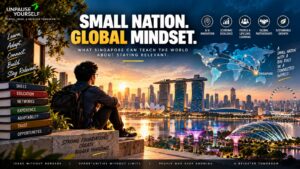
Small Nation, Global Mindset
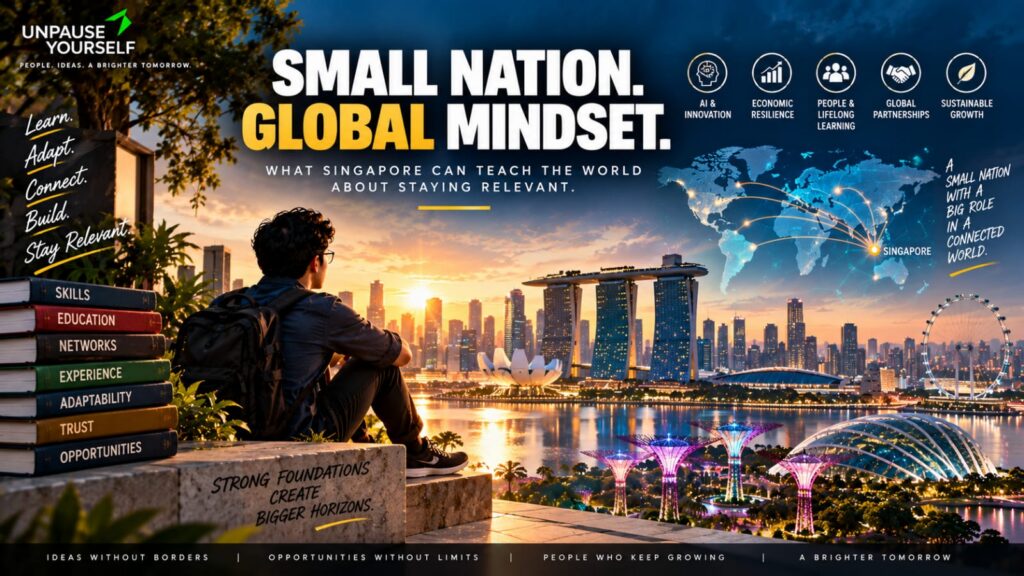
What Singapore Can Teach the World About Staying Relevant in a Changing Global Order
Size determines geography. It does not have to determine relevance.
Look at Singapore on a world map.
It is easy to miss.
The country does not possess a vast domestic market. It does not have enormous reserves of natural resources. Its population is small compared with the world’s major powers.
Yet Singapore occupies an unusually significant position in global trade, finance, aviation, technology and diplomacy.
That alone makes the country interesting.
But Singapore becomes even more interesting when the world becomes uncertain.
Today, artificial intelligence is transforming industries. Geopolitical competition is reshaping supply chains. Trade barriers are returning. Climate and energy transitions are forcing economies to reconsider old models. Careers are changing faster than educational systems traditionally have.
Singapore cannot control most of these forces.
So it is focusing on something it can influence:
Its ability to adapt to them.
That distinction offers lessons far beyond Singapore.
It offers lessons for countries, businesses—and individuals.
A Small Country Has to Think Beyond Its Size
Singapore’s geography creates an unavoidable reality.
Its economic future depends heavily on connections with the rest of the world.
That makes openness not merely an economic preference, but a strategic necessity.
Singapore’s Foreign Minister Vivian Balakrishnan highlighted this reality at the United Nations General Assembly on 26 September 2026, arguing for international law, functioning multilateral institutions and new global rules for emerging technologies. He also noted the extraordinary importance of the Singapore Strait: despite being less than two nautical miles wide at its narrowest point, nearly a quarter of global seaborne trade passes through it.
Think about what that represents.
A geographically small country sits beside one of the arteries of the global economy.
It demonstrates an important principle:
Your importance is not determined only by how much space you occupy. It is determined by how much value flows through you.
That principle applies to individuals as much as nations.
From Openness to Relevance
For decades, globalization rewarded countries capable of connecting capital, goods, talent and ideas.
But the global environment is changing.
Trade is becoming more politically contested.
Supply chains are being reconsidered.
Governments increasingly view technologies, semiconductors, energy and critical infrastructure through the lens of national security.
Singapore’s current Economic Strategy Review openly acknowledges this new reality. It identifies geopolitical fragmentation, artificial intelligence and the green transition as forces reshaping the economy, and organizes its response around three broad imperatives: sharpening Singapore’s value proposition, increasing adaptability and building resilience alongside efficiency.
Notice the language.
Not protection from change.
Adaptability to change.
That is an important difference.
Trying to preserve yesterday indefinitely is rarely a sustainable strategy.
The stronger question is:
How do we remain valuable when the environment around us changes?
AI Is Not Being Treated Merely as a Technology Story
Singapore’s current economic strategy places artificial intelligence near the centre of its future competitiveness.
But there is another side to that strategy.
Workers.
The country is trying to increase AI adoption while simultaneously preparing people for changing jobs.
Singapore’s government says its objective is an “AI transition with no jobless growth”—using AI to increase productivity while helping workers reskill and move into redesigned roles. From 16 September 2026, Singaporeans enrolled in selected SkillsFuture AI courses can receive six months of access to premium AI tools to practise what they learn. Institutes of Higher Learning are also updating curricula and offering selected AI-related courses to alumni at discounted rates.
That represents an important philosophy:
Don’t simply introduce new technology. Prepare people to participate in the economy that technology creates.
For professionals everywhere, the lesson is equally relevant.
The useful question is no longer:
“Will AI affect my profession?”
For many professions, it already is.
The better questions are:
Which parts of my work can AI improve?
Which capabilities become more valuable because of AI?
What should I begin learning now?
Waiting until disruption arrives is expensive.
Learning before it becomes compulsory creates an advantage.
The Numbers Show Why AI Matters
Singapore’s latest trade data provide a striking example of how technological change can influence an entire economy.
Enterprise Singapore reported that non-oil domestic exports increased 46.2% year-on-year in August 2026, following a 24.1% increase in July. Electronics were a major contributor, supported by strong AI-related demand for products including integrated circuits, disk media products and PCs. Total merchandise trade increased 44.5% year-on-year.
These are unusually large movements and should not be interpreted as guaranteed long-term growth.
Indeed, Singapore’s central bank has simultaneously warned that economies benefiting from the AI investment cycle could become vulnerable if global AI spending weakens. MAS nevertheless assessed Singapore’s firms, households and financial institutions as having buffers against current external shocks.
That combination is revealing.
Singapore is trying to capture the opportunity.
But it is also thinking about what happens if the opportunity changes.
Optimism creates growth. Risk awareness creates resilience.
Strong strategy requires both.
Human Capital Is Infrastructure Too
When people hear the word infrastructure, they usually imagine ports, airports, roads, data centres and power systems.
Singapore’s recent policies suggest another interpretation.
People are infrastructure too.
On 24 September 2026, a tripartite workgroup released recommendations aimed at strengthening human-capital capabilities across workplaces. The initiative aspires to benefit more than two million workers, support at least 2,000 enterprises and strengthen the capabilities of 20,000 HR professionals and people leaders. The work was developed against trends including rapid technological advancement and increasing longevity.
This matters because countries can invest billions in technology and still struggle if people cannot use it effectively.
Companies can purchase artificial intelligence systems.
They cannot purchase decades of accumulated human judgement overnight.
They can build infrastructure.
But trust, leadership, adaptability and institutional capability require time.
Technology scales machines.
Education scales people.
The strongest economies will probably need both.
Lifelong Learning Is Becoming Economic Policy
There was once a relatively predictable model of professional life.
Study during your youth.
Earn a qualification.
Enter a profession.
Work for several decades.
Retire.
That model is becoming increasingly difficult to maintain.
Artificial intelligence changes jobs.
People live and work longer.
Industries emerge and disappear faster.
Knowledge becomes outdated.
Singapore’s current economic strategy therefore includes strengthening career transitions and empowering workers to “learn for life” and take greater ownership of their careers.
This may become one of the defining principles of twenty-first-century careers:
Education is no longer a phase before work.
Education is becoming part of work.
The professional of the future may repeatedly move between:
learning → applying → relearning → adapting.
A qualification at 22 cannot reasonably be expected to contain everything someone needs at 42 or 52.
The future belongs increasingly to people who remain intellectually unfinished.
Build Bridges When Others Build Walls
Another interesting element of Singapore’s strategy is its continued investment in international partnerships.
On 2 September, Singapore and Thailand agreed to explore deeper cooperation in areas including artificial intelligence, the digital and green economies, energy resilience, connectivity and food security.
On 28 September, Singapore and the UAE used their joint forum to advance cooperation spanning investment, artificial intelligence, energy, industrial development, capacity building, healthcare and other areas.
Singapore’s Deputy Prime Minister Gan Kim Yong has also recently argued for expanding Singapore-China economic cooperation into areas such as AI and the green economy.
These relationships are different.
The countries involved have different interests and strategic positions.
But collectively they illustrate Singapore’s broader preference for maintaining multiple economic and diplomatic connections.
For individuals, there is an interesting parallel.
Never build your entire world inside one room.
Meet people outside your industry.
Build international relationships.
Understand cultures beyond your own.
Learn how different economies operate.
Talk to people who disagree with you.
Study unfamiliar subjects.
A diverse network does more than create opportunities.
It creates perspective.
Trust Is an Economic Asset
We often think about economic competitiveness in terms of:
tax rates,
infrastructure,
capital,
technology,
and labour costs.
But there is another asset that is harder to quantify.
Trust.
Can contracts be relied upon?
Are regulations reasonably predictable?
Can businesses plan?
Can partners cooperate?
Can institutions function?
Singapore’s Economic Strategy Review explicitly emphasizes strengthening the country’s position as a connected and trusted hub.
Trust is slow to accumulate and remarkably easy to damage.
The same principle applies professionally.
Your qualifications may open a conversation.
Your communication may create an impression.
Your network may create an introduction.
But trust determines whether relationships endure.
Reputation is accumulated behaviour.
Every promise kept makes a deposit.
Every commitment honoured makes a deposit.
Every honest conversation makes a deposit.
Eventually, those deposits become professional capital.
Resilience Is Different From Efficiency
One of the most interesting phrases in Singapore’s current strategy is:
Build resilience alongside efficiency.
For years, businesses optimized relentlessly.
Fewer suppliers.
Lower inventory.
Faster processes.
Lower costs.
Maximum efficiency.
But global disruptions have demonstrated that systems optimized exclusively for efficiency can become fragile.
Sometimes redundancy has value.
Sometimes maintaining alternatives has value.
Sometimes paying slightly more for resilience is rational.
This principle extends into personal life.
Having only one skill can be efficient.
Having complementary skills can be resilient.
Having one professional network can be comfortable.
Having relationships across industries creates resilience.
Depending entirely on one income stream can be simple.
Developing additional capabilities creates options.
Efficiency asks: “How can I optimize today?”
Resilience asks: “What happens if tomorrow changes?”
We increasingly need both.
The Singapore Lesson Is Not “Copy Singapore”
Every country has different geography, history, demographics, institutions and constraints.
Policies successful in Singapore cannot simply be copied elsewhere and expected to produce identical results.
That would miss the larger lesson.
What can travel across borders are principles.
Think beyond your size.
Invest in human capability.
Remain connected.
Build trust.
Learn continuously.
Adopt technology without forgetting people.
Diversify relationships.
Prepare for disruption before it arrives.
Turn limitations into reasons to become more capable.
And above all:
Do not confuse being small with being insignificant.
The Individual Is Also a Small Country
There is a fascinating way to translate Singapore’s story into personal development.
Think of yourself as a small country.
Your skills are your infrastructure.
Your knowledge is your intellectual capital.
Your health is your productive capacity.
Your relationships are your diplomatic network.
Your reputation is your international credibility.
Your savings are your reserves.
Your adaptability is your resilience.
Your values are your constitution.
And your ability to collaborate determines how much opportunity can flow through your world.
You cannot control the global economy.
You cannot control technological disruption.
You cannot control every employer.
You cannot control geopolitical events.
You cannot control who replies to your email.
But you can continually improve the quality of what you bring to the world.
That may be the most useful Singapore lesson of all.
The Unpause Perspective
At Unpause Yourself, we believe the future does not automatically belong to the biggest.
It belongs increasingly to the most adaptable.
The individual who keeps learning.
The organization that keeps evolving.
The city that keeps connecting.
The country that keeps preparing.
Singapore’s current story is not about having discovered a permanent formula for success.
There is no such formula.
Its economy remains exposed to global shocks precisely because it is deeply connected to the world. AI can generate growth while simultaneously disrupting jobs. International trade creates prosperity while geopolitical fragmentation creates vulnerability.
But perhaps resilience does not mean eliminating uncertainty.
Perhaps resilience means becoming capable of navigating it.
The world ahead will be unpredictable.
Technologies will change.
Industries will transform.
Careers will evolve.
Political relationships will shift.
New opportunities will emerge from places we are not currently watching.
The objective therefore cannot be to predict everything.
The objective is to become adaptable enough that you don’t need to.
Singapore may be small on the map.
But it offers a much larger idea:
Your circumstances establish your starting point.
Your capability determines how much you can do from there.
And in a world where change is becoming permanent, perhaps the greatest competitive advantage—whether for a nation, an organization or an individual—is simply this:
Stay useful. Stay connected. Stay curious. Stay ready to change.
About The Author