
The Russia Ukraine War and the Continuing Security Challenge for Europe
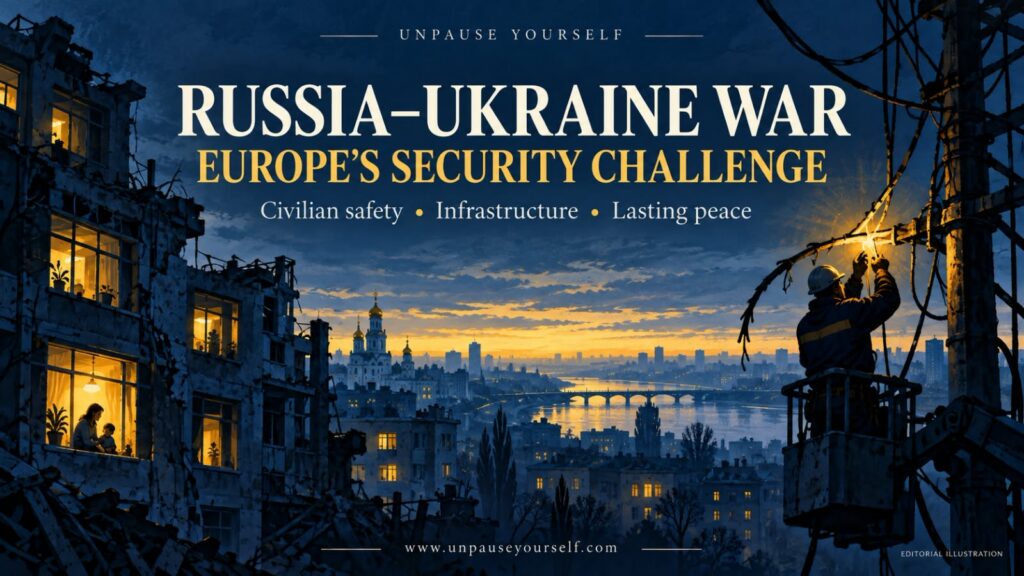
Russia’s latest missile and drone attacks on Ukraine have renewed attention to a difficult European security challenge: how to protect civilians while sustaining support through a prolonged war. Reuters and AP reported deadly strikes on 7 October 2026 affecting Ukrainian cities and infrastructure. Reported casualty totals changed as information emerged, so this explainer focuses on the confirmed pattern of attacks and the policy questions they raise. [1][2]
The debate about the Russia–Ukraine war and European security can seem remote when it centres on weapons systems and budgets. Its immediate meaning is more concrete. People need homes that are safe, electricity that works and emergency services that can respond. Long-term policy is judged partly by whether those everyday conditions can be protected.
What the latest reporting establishes
Reuters described damage to residential buildings and energy infrastructure, alongside renewed Ukrainian requests for air defence. Russia’s defence ministry said it targeted military-industrial facilities. That claim should be distinguished from independently documented damage and Ukrainian accounts of civilian harm. [1]
AP’s reporting also points to the challenge of intercepting incoming weapons and pressure on supplies of defensive systems. These accounts explain the immediate security concern without requiring readers to accept every battlefield statement at face value. [2]
Why air defence remains a recurring issue
Air defence is intended to detect and intercept incoming threats before they reach their targets. It involves equipment, trained personnel, ammunition and coordination. Obtaining a system is therefore only one part of maintaining protection over time.
As a general operational problem, repeated attacks require defenders to replenish resources and decide which locations to prioritise. No single measure can remove every risk. This helps explain why requests for additional defensive support recur even after earlier deliveries have been announced.
Public discussion is more useful when it asks whether promised equipment has arrived, whether crews can operate it and whether supplies can be sustained. A funding pledge and a working capability are different stages of the same process. Treating them as interchangeable can obscure the time required to strengthen protection.
Infrastructure damage can spread beyond the impact site
A damaged electricity facility can affect places far from the point of attack. Water pumping, communications and business activity all depend to varying degrees on reliable power. Backup systems can reduce vulnerability, but they require maintenance and fuel or other energy supplies.
These dependencies explain why civilian resilience deserves attention alongside interception. Repair capacity, emergency planning and alternatives for essential services can reduce disruption when an attack gets through. This is an analytical point about infrastructure systems, rather than a claim that every reported strike has produced every possible effect.
What European governments have to decide
Europe’s policy choices involve immediate assistance and the capacity to sustain it. Governments must consider procurement, industrial production and public finances while responding to Ukraine’s needs. Commitments that extend over time can give planners more certainty, but they also require political support and delivery mechanisms.
Diplomacy remains necessary alongside these decisions. The practical questions include what terms are proposed, how compliance would be assessed and what would happen if commitments were broken. An announcement of talks is a development worth reporting; it is not, by itself, evidence that a settlement is close.
Our editorial assessment is that the security debate should remain connected to civilian outcomes. Equipment counts and spending totals matter insofar as they help explain protection, deterrence or the feasibility of an agreement. They are incomplete measures of whether people can rebuild stable lives.
Why the story matters beyond Europe
For readers elsewhere, the war can have implications through energy markets, trade and diplomatic relationships. Those links should be examined specifically rather than used to suggest that every economic problem has a single cause. The effect on a particular country depends on its exposure and policy choices.
The next developments to watch are verified changes in civilian protection, delivery of promised support, infrastructure recovery and substantive diplomatic proposals. Those indicators offer a clearer picture than dramatic predictions of either imminent peace or unavoidable wider war. Europe’s challenge is to respond to an immediate emergency while making commitments that remain credible over time.
Sources
[1] Reuters — Russian missile and drone strikes, 7 October 2026
[2] Associated Press — Strikes and air defence challenges, 7 October 2026
About The Author