Oil Debt and AI Behind the Latest IMF Warning
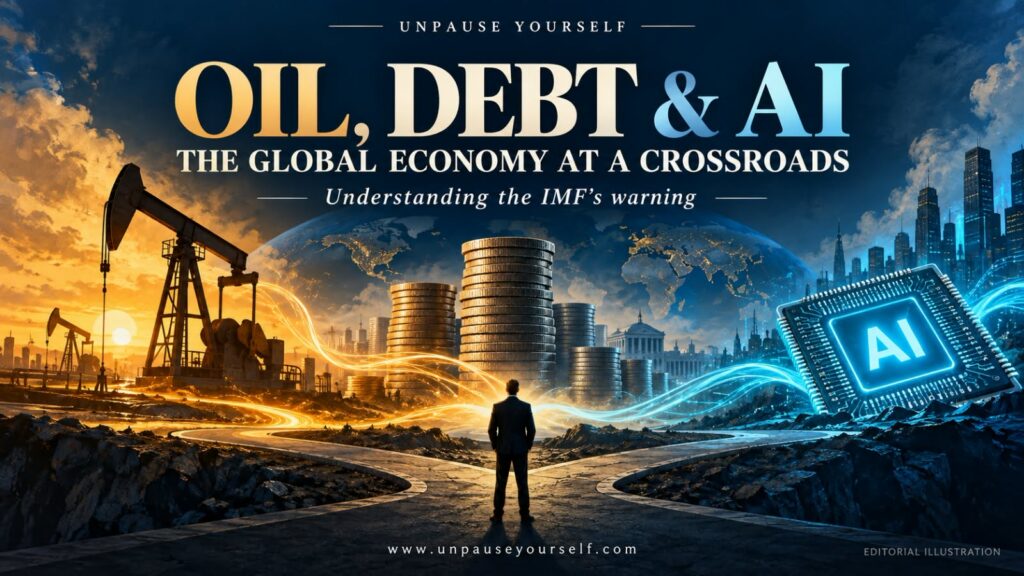
The latest IMF global economy warning brings together three issues often discussed separately: expensive energy, heavy public debt and the rapid expansion of artificial intelligence investment. Reuters reported on 7 October 2026 that IMF Managing Director Kristalina Georgieva warned these pressures could threaten growth and complicate economic policymaking. [1]
For ordinary readers, the significance lies in how these forces interact. An energy shock can increase business costs. Higher borrowing costs can constrain governments’ responses. Meanwhile, major investment in AI creates opportunities but also raises questions about financial expectations, infrastructure capacity and who receives the benefits. The following sections explain those mechanisms; they are not forecasts for a particular country or household.
Why energy prices reach beyond the petrol pump
Energy is an input into transport, manufacturing and many services. When fuel or electricity becomes more expensive, a company may face higher costs even if it does not sell an energy product. A food distributor, for example, needs transport and refrigeration. A manufacturer needs power as well as raw materials.
Some businesses can absorb a temporary increase. Others pass part of it to customers or postpone spending. The eventual effect on consumer prices depends on competition, contracts and the duration of the shock. This is why a rise in international oil prices does not translate into an identical increase in every household bill.
Energy pressures can also complicate inflation control. Interest rates influence borrowing and demand, but they cannot directly repair a damaged energy facility or reopen a disrupted shipping route. Policymakers therefore have to consider both the source of inflation and the costs of slowing economic activity.
What public debt changes
Government borrowing can finance useful investment and support people during a crisis. The difficulty emerges when servicing that debt consumes a growing share of public revenue. More money devoted to interest leaves less flexibility for other spending unless revenue rises or further borrowing fills the gap.
AP’s account of Georgieva’s remarks highlights the pressure from borrowing and interest costs, alongside her call for policy action. It also describes concern about inequality and the distribution of AI’s benefits. [2]
A government facing these pressures must make choices about timing and priorities. Abrupt spending cuts can damage essential services or weaken demand. Delaying adjustments indefinitely can increase vulnerability to a future shock. Evaluating policy therefore requires asking what is being financed, who is affected and whether the approach is sustainable.
Why an AI boom can bring both opportunity and risk
AI investment can support new tools, infrastructure and business processes. However, an investment boom also rests on expectations about future revenue. If expectations run ahead of actual earnings, some projects may prove less profitable than investors anticipated. That possibility does not mean the technology lacks value.
The IMF warning reported by AP includes concern about whether returns from large AI investments will meet expectations. It also points to the importance of worker training and policies that help economies share in the benefits. [2]
Consider a small enterprise adopting AI to assist with customer enquiries. The useful test is whether the tool improves service at an acceptable cost, with human review where needed. Announcing an AI initiative says little about its productivity until the business measures the results. At a wider scale, the same distinction between expenditure and demonstrated value matters.
What this could mean for India
For an Indian reader, the channels to watch include imported energy costs, overseas demand for goods and services, and changes in technology investment. These are possible transmission routes, not a prediction that India will experience every risk in the same way as another economy.
Businesses can interpret the news through concrete indicators: supplier costs, order volumes, financing terms and the results of technology spending. Workers can distinguish between headlines about total investment and evidence that particular skills or roles are gaining demand. A global warning is most useful when translated into questions that can be checked.
Reading the warning without assuming a recession
A warning about risks is not an announcement that a recession is inevitable. Reuters’ report did not establish a new growth forecast from the remarks alone. [1] Our reading is that the interaction of energy, debt and investment deserves attention because it can narrow policymakers’ room to respond. The next useful evidence will be published forecasts and observable economic outcomes, rather than certainty drawn from a single speech.
Sources
[1] Reuters — IMF warning on energy, debt and AI, 7 October 2026
[2] Associated Press — IMF chief urges action on debt and AI, 7 October 2026
[3] IMF — Official 2026 Annual Meetings event information
About The Author