Three Years After October 7 and the Human Cost of the Israel Gaza Conflict
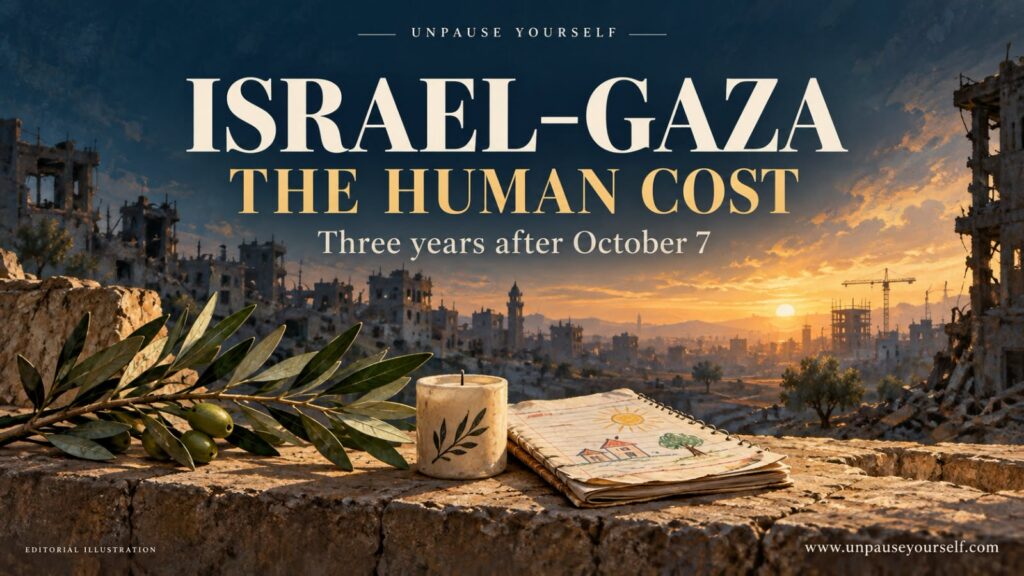
Three years after the Hamas-led attacks of 7 October 2023, the Israel–Gaza conflict remains a story of civilian loss and an unfinished struggle to restore everyday life. Reuters’ anniversary reporting describes Israelis remembering those killed and Palestinians confronting the destruction of their communities. The anniversary brings renewed attention to a question that diplomatic announcements alone cannot answer: what would meaningful security look like for the people who have lived through this conflict? [1]
Understanding the human cost of the Israel–Gaza conflict requires looking beyond an individual day’s headlines. Grief, serious injury, displacement and interrupted childhoods continue after an event disappears from the news. A family’s recovery depends on whether it can live somewhere safe, obtain treatment, earn an income and plan for tomorrow.
What the anniversary asks us to remember
The attacks of October 2023 and the hostage-taking left enduring trauma in Israel. Recognising that suffering does not require overlooking Palestinian civilians’ suffering during the subsequent war. Equally, describing the devastation in Gaza should never become a reason to minimise the killing and abduction of civilians in Israel.
The International Committee of the Red Cross reported in January 2026 that it had completed release and transfer operations under the ceasefire agreement. Its account explains that bringing people home also included returning the deceased so families could mourn. This distinction matters: reunion and bereavement are different experiences, and neither can be reduced to a diplomatic milestone. [2]
Why the humanitarian emergency continues
OCHA’s 2 October 2026 situation report describes preparations for rain and flooding among displaced communities in Gaza. Humanitarian teams are working on drainage, shelters and water infrastructure, while insecurity, funding gaps and restrictions on supplies constrain their efforts. The report also warns that underfunding could reduce food assistance during October. [3]
These practical problems help explain why a ceasefire announcement does not immediately restore normal life. A damaged home may remain unsafe even when nearby fighting subsides. Repairing a water system requires equipment, electricity and access for workers. Medical services need reliable supplies as well as staff. Recovery depends on these systems functioning together.
The damage that outlasts the headlines
The ICRC’s account of its work during the first half of 2026 states that violence, injuries and displacement continued despite the October 2025 ceasefire. That is an important reminder to assess conditions on the ground alongside political commitments. [4]
For children, repeated disruption can make school attendance and friendships difficult to maintain. For adults, losing a workplace or the documents needed to establish ownership can complicate rebuilding. These are general consequences of displacement, not claims about every family’s experience. They show why an assessment of recovery must ask more than how many buildings have been repaired.
What meaningful recovery would require
A credible recovery effort should make civilian safety its starting point. It would need dependable humanitarian access, functioning health services and shelter that can withstand seasonal weather. Longer-term work would involve education, livelihoods and a political framework in which people can expect their rights and security to endure.
Accountability also matters. Investigations into specific acts should follow evidence and distinguish civilians from governments and armed groups. Holding individuals or institutions responsible is different from assigning guilt to an entire population. Reporting that preserves this distinction helps readers understand events without encouraging collective blame.
How readers can judge the next developments
When new agreements or reconstruction pledges are announced, ask what changes for civilians. Are assistance deliveries becoming more reliable? Can patients reach treatment? Can families return voluntarily to safe homes? Are schools able to operate consistently? These questions offer a more useful measure of progress than the language of a press conference.
At Unpause Yourself, our editorial view is that human dignity should remain central to the story. Remembering the victims and examining present suffering belong in the same conversation. The strongest evidence of progress will be the gradual return of safety and ordinary choices to civilian life.
Sources
[1] Reuters — Anniversary reporting, 7 October 2026
[2] ICRC — Release and transfer operations completed, 29 January 2026
[3] OCHA — Humanitarian Situation Report, 2 October 2026
[4] ICRC — Work in Israel and the occupied territories, January to June 2026
About The Author