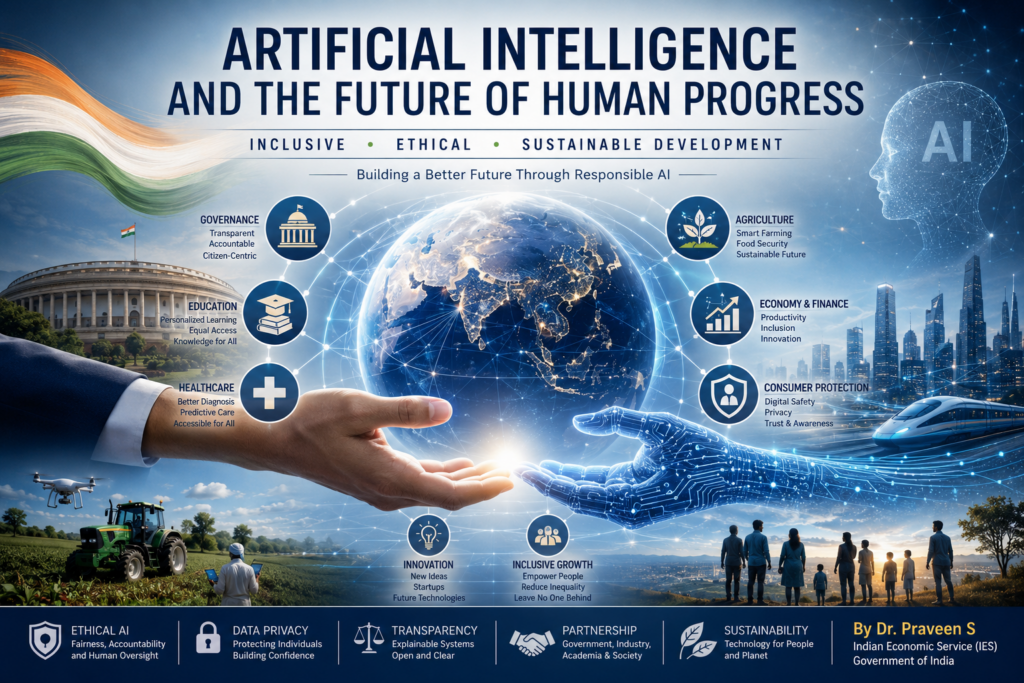
Artificial Intelligence and the Future of Human Progress: A Policy Perspective for Inclusive, Ethical and Sustainable Development
About the Author
Dr. Praveen S is an officer of the Indian Economic Service (IES) currently serving as Deputy Director in the Ministry of Corporate Affairs, Government of India. With extensive expertise in economic policy, corporate governance, and investor protection, he has held key roles across labor administration, finance, and public governance. As an accomplished author and researcher, Dr. Praveen contributes regularly to the discourse on emerging technologies and consumer awareness.
He is the author of the books “How to Protect Yourself from the Risks of Artificial Intelligence: Strategies and Solutions for Individuals and Businesses” and 4 volumes of the book Business and Consumer Education”
Artificial Intelligence (AI) has rapidly evolved from a specialized technological concept into one of the most influential forces shaping the modern world. Across governments, industries, educational institutions, financial systems, and households, AI is transforming the manner in which decisions are made, services are delivered, and opportunities are created. Similar to the transformative impact of electricity, the internet, and mobile communications, AI has emerged as a foundational technology capable of redefining economic growth, governance, and human development.
Having worked across various ministries and institutions associated with economic policy, corporate affairs, labour administration, finance, legal governance, consumer awareness, and public administration, I have witnessed how technological innovations can create immense societal value when accompanied by responsible governance. Artificial Intelligence presents one of the greatest opportunities of our generation, but it also demands careful reflection regarding ethics, accountability, transparency, employment, privacy, and consumer protection.
The global discussion on AI often swings between enthusiasm and apprehension. Some perceive AI as a solution to nearly every human challenge, while others view it as a threat to employment, privacy, and social stability. In reality, AI is neither inherently beneficial nor inherently harmful. Its impact depends upon the intentions, policies, institutions, and ethical frameworks that govern its development and use.
For India, AI represents not merely a technological advancement but a strategic national opportunity. The decisions we make today will influence our economic competitiveness, social inclusiveness, and developmental trajectory for decades to come.
THE ECONOMIC IMPERATIVE OF AI
The world is entering an era where data, algorithms, and intelligence-driven systems are becoming critical economic assets. AI is already enhancing productivity across sectors including manufacturing, healthcare, education, logistics, agriculture, retail, and financial services.
Businesses increasingly use AI for predictive analytics, customer engagement, risk management, fraud detection, process optimization, and strategic planning. Organizations capable of effectively integrating AI into their operations are likely to achieve significant competitive advantages.
For developing economies such as India, AI can help accelerate growth by improving productivity, reducing inefficiencies, and enabling innovative solutions to longstanding challenges. From smart agriculture and intelligent healthcare systems to digital education and financial inclusion, AI possesses the potential to generate both economic and social value at scale.
India’s digital public infrastructure, expanding startup ecosystem, strong technology talent pool, and entrepreneurial culture provide a solid foundation for becoming a global leader in responsible AI adoption.
AI AND PUBLIC GOVERNANCE
The public sector stands to benefit significantly from Artificial Intelligence. Governments generate and manage vast amounts of data. AI can help transform this data into actionable insights that improve decision-making, policy implementation, and service delivery.
Potential applications include predictive public health systems, welfare scheme optimization, urban planning, infrastructure management, tax administration, grievance redressal, and regulatory compliance monitoring.
However, governance involves more than efficiency. Public trust, accountability, fairness, and transparency remain fundamental principles. AI-supported systems should complement human judgment rather than replace institutional responsibility. Citizens must retain confidence that public decisions remain explainable, accountable, and aligned with democratic values.
THE IMPORTANCE OF TRUST AND RESPONSIBLE AI
Trust is perhaps the most valuable currency in the AI era. Without public trust, even the most sophisticated technologies may fail to achieve meaningful adoption.
Responsible AI requires transparency, fairness, accountability, privacy protection, and human oversight. Organizations deploying AI should clearly communicate how systems function, how data is utilized, and how decisions are made.
Algorithmic bias remains a major concern. AI systems trained on incomplete or biased data may unintentionally perpetuate existing inequalities. Therefore, fairness assessments, auditing mechanisms, and governance frameworks should become integral components of AI deployment strategies.
Responsible innovation should not be viewed as a constraint. Rather, it serves as a foundation for sustainable technological progress.
AI, CONSUMER PROTECTION AND DIGITAL SAFETY
One area that deserves special attention is consumer protection. As AI-powered systems increasingly influence purchasing decisions, financial transactions, content recommendations, and online interactions, consumers face new opportunities and risks.
Consumers may not always understand how AI systems make recommendations or decisions. The growing sophistication of generative AI tools can blur the distinction between authentic and synthetic content. Deepfakes, manipulated information, fraudulent communications, and identity impersonation are becoming increasingly sophisticated.
Consumer awareness therefore becomes essential. Digital literacy should include an understanding of AI-generated content, privacy considerations, cybersecurity risks, and responsible online behavior.
Policymakers, regulators, educational institutions, businesses, and civil society organizations must collaborate to strengthen public awareness and safeguard consumer interests in the digital economy.
THE FUTURE OF WORK: EVOLUTION, NOT EXTINCTION
Perhaps no issue generates more discussion than the impact of AI on employment.
Throughout history, technological revolutions have transformed labour markets. While certain occupations disappear or evolve, new industries, professions, and opportunities emerge. Artificial Intelligence is likely to follow a similar pattern.
Routine and repetitive tasks are increasingly susceptible to automation. However, uniquely human capabilities such as creativity, emotional intelligence, critical thinking, leadership, negotiation, ethical reasoning, and innovation will become even more valuable.
The future workforce will require continuous learning and adaptability. Governments, educational institutions, and employers must invest in reskilling and upskilling initiatives to prepare citizens for emerging opportunities.
Educational systems should emphasize not only technical competence but also problem-solving, communication, collaboration, and lifelong learning.
EDUCATION IN THE AGE OF AI
Education will play a decisive role in determining whether societies benefit from AI or struggle with its disruptions.
AI-powered learning systems can personalize education, improve accessibility, and enhance learning outcomes. Students can receive individualized support based on their unique learning needs and preferences.
At the same time, educational institutions must ensure that technology enhances learning rather than diminishing critical thinking. Students should learn how to use AI responsibly while maintaining independent reasoning, analytical capabilities, and intellectual curiosity.
The objective should not be to replace teachers with technology but to empower educators with better tools and resources.
INDIA’S OPPORTUNITY TO LEAD
India possesses several advantages in the emerging AI landscape. The country’s large population, digital infrastructure, entrepreneurial ecosystem, and growing innovation capabilities position it favorably for leadership.
Initiatives promoting digital governance, financial inclusion, startup development, and technology adoption have already demonstrated India’s capacity to implement large-scale digital transformation.
The next phase should focus on strengthening AI research, promoting responsible innovation, investing in talent development, supporting startups, and fostering collaboration between government, academia, industry, and civil society.
India also has an opportunity to contribute to global conversations regarding ethical AI, inclusive development, and technology governance.
THE NEED FOR BALANCED REGULATION
Innovation and regulation should not be viewed as competing objectives. Effective governance frameworks can encourage innovation while protecting societal interests.
AI regulation should be principles-based, risk-sensitive, and adaptive. Regulatory approaches should support innovation while addressing concerns relating to privacy, security, transparency, accountability, and consumer welfare.
International cooperation will be increasingly important because AI-related challenges frequently transcend national borders. Collaborative frameworks can help establish common standards and best practices.
HUMAN VALUES MUST REMAIN CENTRAL
Artificial Intelligence is powerful, but it is not human.
AI can analyze information, identify patterns, and automate processes. However, it does not possess empathy, wisdom, morality, or ethical judgment. These qualities remain uniquely human.
The future should not be framed as a competition between humans and machines. Instead, it should be understood as a partnership in which technology augments human capabilities while humans provide vision, values, and accountability.
The most successful societies will be those that combine technological innovation with ethical leadership and human-centered governance.
CONCLUSION
Artificial Intelligence represents one of the defining technologies of the twenty-first century. Its influence will continue to expand across every aspect of society, from economic development and governance to education, healthcare, and daily life.
The true measure of AI’s success will not be the sophistication of algorithms or the speed of automation. Rather, it will be the extent to which these technologies improve human well-being, strengthen institutions, promote inclusion, and create sustainable opportunities.
The responsibility before policymakers, businesses, educators, researchers, and citizens is clear. We must ensure that AI remains aligned with human values, democratic principles, and societal welfare.
If guided by wisdom, accountability, inclusiveness, and ethical leadership, Artificial Intelligence can become one of humanity’s greatest instruments for progress. Our goal should not merely be to create intelligent systems, but to build a more intelligent, equitable, resilient, and compassionate society.
Amazon Book Link :
https://amzn.in/d/0eKzaxdA
That, in my view, is the true promise of Artificial Intelligence.
About The Author