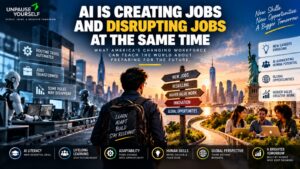
AI Is Creating Jobs and Disrupting Jobs at the Same Time
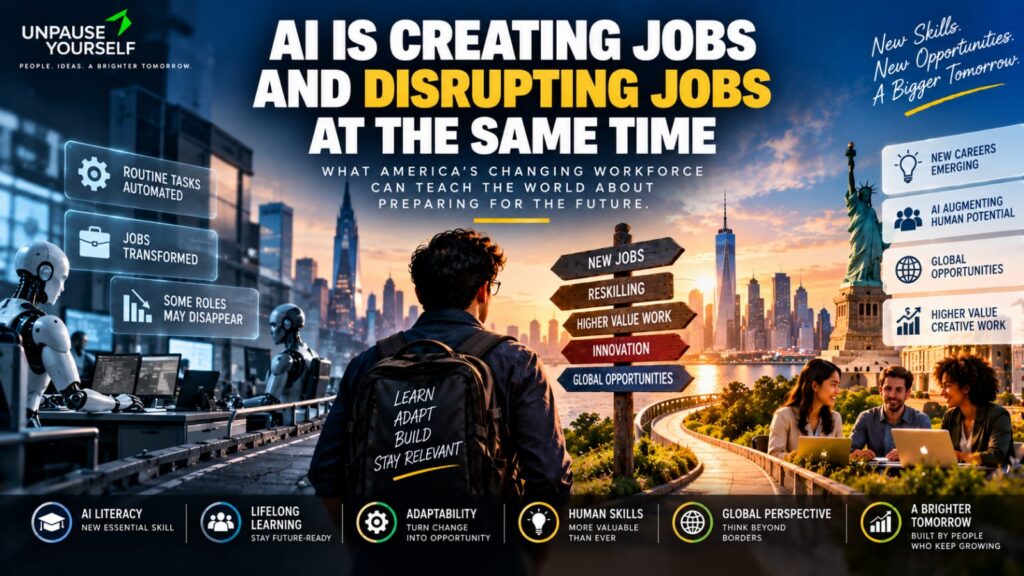
What America’s Changing Workforce Can Teach the World About Preparing for the Future
The question is no longer whether artificial intelligence will change work. The more important question is whether we will change with it.
For decades, technology has carried a contradiction.
Every major technological transformation creates excitement about what becomes possible—and anxiety about what might disappear.
Machines transformed factories.
Computers transformed offices.
The internet transformed communication and commerce.
Smartphones transformed entire industries.
Now artificial intelligence is beginning another transformation.
And nowhere is this tension more visible than in the United States.
AI companies are attracting investment. Data centres and supporting infrastructure are expanding. Organizations are experimenting with automation. New AI-related capabilities are becoming valuable.
At the same time, workers are asking an uncomfortable question:
“What happens to my job?”
That concern is real.
Gallup reported in September 2026 that 27% of U.S. workers worry technology could make their jobs obsolete, the highest share recorded since Gallup began asking the question in 2017. Among workers aged 18–44, the figure reaches 34%. Yet Gallup also notes that overall AI-related employment displacement remains modest so far.
This creates one of the most important career paradoxes of our time:
AI can create opportunity and disruption simultaneously.
Understanding that paradox may be more useful than trying to decide whether AI is simply “good” or “bad” for jobs.
The Wrong Question: “Will AI Take Our Jobs?”
This question is understandable.
But it may be too simplistic.
A job is rarely one activity.
A marketing professional researches, writes, analyzes, communicates and makes decisions.
A software developer writes code, diagnoses problems, understands requirements and collaborates with teams.
A lawyer researches, drafts, negotiates and exercises judgement.
A teacher explains concepts, evaluates students, motivates people and manages human relationships.
Artificial intelligence may automate or accelerate some tasks without eliminating the entire occupation.
Other occupations may shrink.
Some may expand.
Entirely new categories of work may emerge.
The transformation is therefore likely to be uneven.
Recent American evidence illustrates exactly why we should avoid extreme predictions. S&P Global has identified job losses in some highly AI-exposed sectors even while describing the broader U.S. labour market as relatively strong. Separately, new research on recent American college graduates found no statistically significant AI-related unemployment increase among graduates seeking jobs in occupations considered particularly exposed to AI.
The story is still developing.
And that uncertainty itself is important.
Fear Is Growing Faster Than Displacement
Something fascinating is happening in the American workforce.
Workers’ expectations may be changing faster than the labour market itself.
Gallup’s September survey found that concern about technological displacement has approximately doubled from 13% in 2017 to 27% in 2026.
Among college graduates, worry increased from 8% in 2021 to 25% in 2026.
Education, therefore, does not automatically eliminate anxiety about technological disruption.
Why?
Because AI is reaching occupations previously considered relatively protected from automation.
Writing.
Programming.
Analysis.
Design.
Research.
Customer support.
Administrative work.
Professional services.
Technology is no longer affecting only repetitive physical tasks.
It increasingly interacts with cognitive work.
That changes the psychological relationship professionals have with technology.
But Fear Is Not a Career Strategy
Concern can be useful.
Panic rarely is.
If someone spends the next five years worrying that AI might affect their profession while doing nothing to understand AI, they have converted uncertainty into vulnerability.
A more useful response is:
Learn the technology that is changing your profession.
You do not necessarily need to become an AI engineer.
A lawyer should understand how AI affects legal research and drafting.
A marketer should understand AI-assisted content, analytics and personalization.
A teacher should understand AI-assisted learning.
An entrepreneur should understand automation and productivity tools.
A financial professional should understand how AI changes analysis and customer experience.
A student should understand how AI is changing the profession they hope to enter.
The objective is not:
“Learn AI because AI is fashionable.”
It is:
Understand how AI changes the economics of your own work.
From Job Security to Skill Security
For much of the twentieth century, career security was often associated with an employer.
Find a good organization.
Get a permanent position.
Accumulate experience.
Receive promotions.
Remain for decades.
That model has already been weakening.
AI may accelerate the transition toward another form of security:
Skill security.
Job security asks:
«“Will this organization continue needing my current position?”»
Skill security asks:
«“If this position changes tomorrow, do I possess capabilities that remain valuable?”»
That is a fundamentally different way of thinking.
Your employer can change.
Your industry can change.
Technology can change.
But portable capabilities travel with you.
Communication.
Critical thinking.
Data literacy.
Leadership.
Negotiation.
Domain expertise.
Creativity.
Problem solving.
Relationship building.
AI literacy.
Judgement.
Adaptability.
These form a kind of professional insurance.
The Most Valuable Worker May Not Be the One Who Competes With AI
Imagine two employees.
The first refuses to use AI because they believe their traditional method is superior.
The second uses AI for everything and gradually stops thinking independently.
Both approaches contain risk.
The first may become inefficient.
The second may become dependent.
The stronger professional occupies the middle ground.
They know:
when to use AI,
how to question AI,
how to verify AI,
when not to use AI,
and most importantly,
how to add something that AI alone cannot provide.
Context.
Experience.
Accountability.
Ethical judgement.
Human understanding.
Original perspective.
The future advantage may not belong to humans fighting machines.
It may belong to humans who become exceptionally good at working with machines without surrendering their judgement to them.
AI Literacy Is Becoming Basic Professional Literacy
There was a time when knowing how to use a computer was considered a specialized capability.
Eventually it became normal.
The same happened with email.
Search engines.
Spreadsheets.
Video conferencing.
Digital collaboration.
AI may follow a similar trajectory.
What appears today as an advanced skill may eventually become an expected workplace capability.
Gallup’s 2026 research shows that AI use has already become increasingly common in American workplaces, even while workers remain uncertain about its consequences.
This means schools, universities and training institutions face an important challenge.
They cannot simply teach students about AI.
They must help students learn how to work intelligently with AI.
Education Must Move From Memorization to Judgement
If artificial intelligence can retrieve information, summarize documents, generate drafts and solve increasingly complex problems, education must ask:
What should humans become exceptionally good at?
Perhaps the answer includes:
asking better questions,
evaluating evidence,
recognizing misinformation,
connecting disciplines,
communicating clearly,
understanding human behaviour,
making ethical decisions,
and exercising judgement when information is incomplete.
This does not make knowledge irrelevant.
Quite the opposite.
You need knowledge to recognize when AI is wrong.
But the purpose of education increasingly cannot be simply to store information.
It must develop the ability to interpret and use information intelligently.
The Entry-Level Problem Deserves Attention
There is another issue that should concern educators and employers.
Traditionally, junior professionals learned by performing relatively basic tasks.
Research.
Drafting.
Documentation.
Basic coding.
Data preparation.
Routine analysis.
Administrative work.
But these are precisely the types of tasks AI can increasingly assist with.
That creates an interesting challenge.
If technology performs more beginner-level work, how will beginners acquire the experience required to become experts?
This is not merely an employment question.
It is a talent-development question.
Companies may need to redesign entry-level roles rather than simply eliminate routine tasks.
Universities may need to provide more applied experience.
Students may need portfolios, internships, projects and demonstrable capabilities earlier.
Mentorship may become more important.
The pathway from novice to expert cannot disappear simply because some novice tasks become automated.
Don’t Collect Qualifications. Build Capability.
This transition also changes how we should think about education.
A degree matters.
A certification can matter.
An executive programme can matter.
But the labour market increasingly asks another question:
What can you actually do?
Do not collect qualifications merely because they look impressive on a profile.
Build an intellectual architecture.
If you study management, understand technology.
If you study technology, understand business.
If you study finance, develop communication.
If you study communication, understand data.
If you are a specialist, develop enough interdisciplinary awareness to understand the larger system around your work.
The future may reward people who can connect disciplines that were previously separated.
Build a Portfolio of Capabilities
Imagine your career as an investment portfolio.
Putting everything into one asset creates concentration risk.
Careers can have concentration risk too.
If your professional identity depends entirely on one narrow task that technology can perform increasingly well, your vulnerability increases.
Instead, build complementary assets.
Your portfolio might contain:
Domain expertise + AI literacy + communication + leadership + international perspective + relationships + reputation.
Another person’s portfolio may look completely different.
That is fine.
The objective is not to become good at everything.
It is to create a combination of capabilities that makes you difficult to replace and easy to redeploy.
Human Skills May Become More Valuable, Not Less
Paradoxically, the more capable machines become, the more visible certain human abilities may become.
Trust.
Empathy.
Leadership.
Negotiation.
Persuasion.
Responsibility.
Mentorship.
Cultural understanding.
Strategic judgement.
People do not merely want information.
They want someone capable of understanding what the information means for them.
A machine may produce ten strategies.
A leader must decide which strategy an organization should pursue.
AI may generate a medical explanation.
A healthcare professional carries responsibility for care.
AI can produce a presentation.
A human still has to enter the room, understand the audience and earn trust.
Technology changes the value chain.
It does not automatically remove humans from it.
AI Will Not Affect Every Worker Equally
This point is crucial.
Technological transformation creates winners, losers and complicated outcomes in between.
Some workers may become dramatically more productive.
Some occupations may experience wage pressure.
Some entry-level opportunities may become harder to access.
Some entirely new professions may emerge.
Some workers will have access to excellent retraining.
Others will not.
Some organizations will use AI to augment employees.
Others may use it primarily to reduce costs.
This is why simplistic predictions are dangerous.
Even Federal Reserve Governor Lisa Cook said this week that she currently sees little evidence that AI is already remaking the structure of the U.S. labour market, while remaining attentive to the possibility of future employment effects.
We should therefore avoid pretending that anyone already knows precisely how this transformation ends.
The Career Question Has Changed
For students, professionals and entrepreneurs around the world, perhaps the question should no longer be:
“Which career is safe from AI?”
Very few careers are completely isolated from technological change.
Instead ask:
Which problems will society continue needing humans to solve?
Where can AI amplify my capability?
Which parts of my profession are becoming automated?
Which capabilities are becoming more valuable?
What can I begin learning before I urgently need it?
Those questions create agency.
Learn Before You Need To
One of the most powerful career advantages is learning something before circumstances force you to learn it.
Do not wait for your company to announce restructuring before understanding AI.
Do not wait until your profession changes before developing complementary skills.
Do not wait until you need a new job before building relationships.
Do not wait until your résumé becomes outdated before acquiring new qualifications.
Do not wait until disruption arrives before becoming adaptable.
Preparation is cheaper before the emergency.
The World Should Watch America—but Not Copy It Blindly
The United States is particularly important in the AI transformation because many of the world’s leading AI companies, investors, universities and technology ecosystems operate there.
But what happens in America will not automatically happen everywhere in exactly the same way.
India has a different labour market.
Europe has different regulations and demographic conditions.
Southeast Asia has different development patterns.
Africa has different opportunities and constraints.
Countries will experience AI differently.
Yet the American experience can function as an early laboratory.
It can help the rest of the world ask questions before the answers become urgent.
How should universities change?
How should entry-level jobs evolve?
Who pays for reskilling?
How should organizations measure productivity?
How do we protect workers without preventing innovation?
How do we ensure AI expands human capability rather than merely concentrating its benefits?
These are no longer technology questions.
They are economic and social questions.
The Unpause Perspective
At Unpause Yourself, we believe technological change should not create technological paralysis.
Nobody can promise exactly what the labour market of 2035 will look like.
That uncertainty can be frightening.
But uncertainty also means the future has not been completely decided.
There is still time to prepare.
Learn.
Experiment.
Build qualifications with purpose.
Strengthen human skills.
Understand AI.
Develop judgement.
Build relationships.
Create a body of work.
Stay internationally aware.
Become comfortable being a beginner repeatedly.
And perhaps most importantly:
Do not build your identity around a job title. Build it around your ability to create value.
A designation can disappear.
A company can restructure.
A technology can change.
An industry can decline.
But someone capable of learning, adapting, communicating and solving meaningful problems possesses something far more durable.
The AI revolution may create jobs.
It may eliminate some jobs.
It will almost certainly change many jobs.
But perhaps the most important divide of the coming decade will not simply be:
Humans versus artificial intelligence.
It may increasingly be between:
people who continuously adapt—and people who assume what worked yesterday will remain sufficient tomorrow.
Do not fear the future.
Do not blindly celebrate it either.
Prepare for it.
Because the safest career may no longer be the one protected from change.
It may be the career of someone who has learned how to change with it.
About The Author