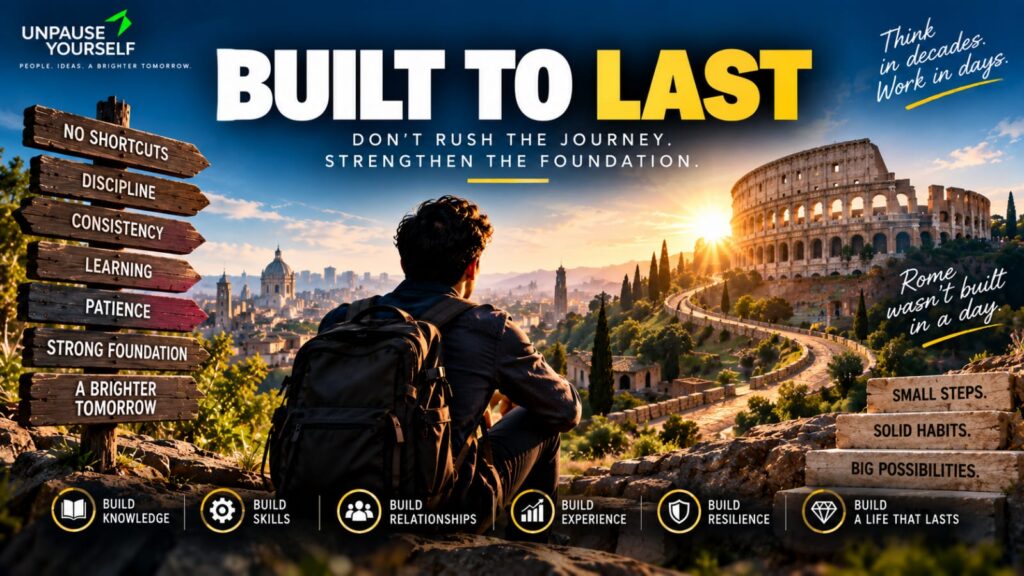
Built to Last
Why the Strongest Success Takes Time
We live in a world obsessed with speed. But some of the most important things in life cannot be rushed.
We want faster careers.
Faster businesses.
Faster promotions.
Faster recognition.
Faster wealth.
Faster audiences.
Faster results.
We watch someone announce a successful startup, receive an award, publish a book, speak on a prestigious stage or reach an impressive professional milestone—and naturally notice the achievement.
What we rarely see is everything underneath it.
The years of learning.
The failed attempts.
The qualifications.
The difficult conversations.
The relationships built slowly.
The work done without recognition.
The mistakes corrected privately.
The days when progress appeared almost invisible.
In an age of instant gratification, perhaps we need to rediscover an old truth:
Slow and steady does not mean thinking small. It means building strong enough to go far.
Rome Wasn’t Built in a Day—and Neither Are You
The familiar expression “Rome wasn’t built in a day” survives because its message remains relevant.
Anything substantial requires construction.
A meaningful career is constructed.
A credible reputation is constructed.
A successful organization is constructed.
Expertise is constructed.
Relationships are constructed.
Financial stability is constructed.
Character is constructed.
And before something impressive can rise upward, something much less glamorous must usually be built underneath it:
a foundation.
Foundations rarely receive applause.
Nobody photographs the foundations of a skyscraper and says, “What an extraordinary building.”
Yet remove them, and everything above becomes vulnerable.
Your life works similarly.
Build Down Before You Build Up
Imagine two buildings.
The first rises extremely quickly.
From the outside, it looks impressive.
Floor after floor appears.
But construction was rushed. Materials were compromised. Engineering was ignored. The foundation was shallow.
The second building appears frustratingly slow.
For months, observers see little progress because much of the work is happening underground.
Then construction begins above the surface.
Eventually both buildings may appear equally tall.
But when pressure arrives, their differences become visible.
Careers and businesses can work the same way.
Before chasing visibility, build capability.
Before chasing titles, build competence.
Before chasing followers, build credibility.
Before chasing international opportunities, build perspective.
Before seeking investment, understand your business.
Before trying to lead others, learn to manage yourself.
Build down before you build up.
The stronger the foundation, the greater the weight it can eventually carry.
The Shortcut Economy
Modern technology has created extraordinary efficiency.
Things that once took weeks can sometimes be accomplished in hours.
That is progress.
But efficiency and shortcuts are not always the same thing.
A tool can accelerate work.
It cannot replace judgement.
Artificial intelligence can help you understand a subject.
It cannot instantly give you years of experience.
A social-media strategy can increase visibility.
It cannot manufacture genuine credibility indefinitely.
A certificate can demonstrate completion of a programme.
It cannot replace capability.
A powerful introduction can open a door.
It cannot guarantee that you deserve to remain inside.
A shortcut can occasionally get you somewhere faster.
But if you arrive without the capability required to stay there, speed becomes irrelevant.
Access can be accelerated. Readiness cannot always be.
Don’t Skip the Boring Years
Almost every meaningful journey contains periods that appear uneventful.
You are learning.
Practising.
Reading.
Saving.
Experimenting.
Working.
Meeting people.
Building credibility.
Making mistakes.
Improving.
From the outside, almost nothing seems to be happening.
These are the years people are tempted to skip.
But they may become the most important years of all.
A musician repeats scales before performing on stage.
An athlete trains thousands of hours before competing professionally.
A researcher spends years understanding a field before producing important work.
An entrepreneur may spend years understanding customers before building the right company.
A public speaker may practise hundreds of times before appearing effortless.
The visible performance is often merely the final layer.
The invisible preparation created it.
Compounding Loves Patience
We understand compound interest in finance.
Small amounts invested consistently can become surprisingly large over time.
But compounding exists beyond money.
Knowledge compounds.
Skills compound.
Relationships compound.
Reputation compounds.
Health habits compound.
Communication ability compounds.
Professional credibility compounds.
Suppose you become just slightly better at something each week.
For several weeks, the difference may be almost invisible.
Continue for years and the gap becomes enormous.
This is why consistency can outperform occasional intensity.
Working eighteen hours one day and disappearing for ten days is rarely as powerful as sustained, disciplined effort.
Intensity can create a moment. Consistency can create a life.
The Bamboo Lesson
Nature rarely rushes, yet it produces extraordinary things.
A seed does not become a tree overnight.
Roots develop before branches can carry weight.
The same principle applies to human development.
Sometimes you are learning without receiving opportunities.
Sometimes you are networking without seeing immediate results.
Sometimes you are improving without receiving recognition.
Sometimes you are working while someone else appears to be moving faster.
Do not automatically interpret invisible progress as no progress.
Roots are progress too.
And when the right opportunity eventually arrives, the preparation that nobody saw may determine whether you can handle it.
Stop Comparing Chapter Three With Someone Else’s Chapter Twelve
One reason people chase shortcuts is comparison.
You see someone your age—or younger—achieving something you want.
Immediately, the internal clock starts.
“I’m behind.”
But you rarely know their complete story.
Perhaps they started ten years earlier.
Perhaps they had different resources.
Perhaps they had mentors you did not.
Perhaps they sacrificed things you value.
Perhaps what appears successful externally is not sustainable internally.
Comparison removes context.
The more useful comparison is simpler:
Am I building better than I was yesterday?
You do not need to travel at someone else’s speed.
You need to make sure your direction deserves your effort.
Speed Without Direction Is Dangerous
Imagine driving extremely fast in the wrong direction.
Your speed is impressive.
Your destination is getting farther away.
Modern professional culture sometimes rewards movement so much that we forget to examine direction.
Another meeting.
Another certificate.
Another project.
Another social-media post.
Another event.
Another business idea.
Another collaboration.
Activity creates the feeling of progress.
But activity and progress are not identical.
Periodically ask:
Why am I doing this?
What am I building?
Does this strengthen my foundation?
Will this still matter three years from now?
The goal is not to become slower for the sake of being slow.
The goal is to become deliberate.
Build Skills Before Status
Status is visible.
Skill often isn’t.
That creates temptation.
People may chase designations before competence.
Followers before ideas.
Media visibility before meaningful work.
Funding before business fundamentals.
Leadership positions before learning how to lead.
But status without substance is fragile.
A title may get attention.
Capability earns respect.
Recognition may create an introduction.
Competence creates longevity.
You should certainly pursue opportunities.
But alongside every external milestone, ask:
What am I becoming capable of?
Because eventually, opportunity tests preparation.
Build Relationships Slowly Too
Strong relationships rarely emerge from one message.
Trust accumulates.
You meet someone.
You communicate occasionally.
You exchange ideas.
You help without immediately expecting something in return.
You remain respectful.
Months pass.
Sometimes years.
Eventually, the relationship develops depth.
This applies to mentors, colleagues, clients, collaborators and international connections.
Do not treat every person as an opportunity.
Treat people as people.
The strongest professional relationships often become valuable precisely because they were not built around immediate transactions.
Networks become powerful when relationships precede requirements.
Qualification Is Useful—Capability Is Essential
Education deserves the same patience.
There is nothing wrong with collecting meaningful qualifications.
Learn.
Take courses.
Read books.
Attend workshops.
Study internationally.
Earn certifications relevant to your direction.
But don’t simply accumulate certificates.
Build knowledge beneath them.
If you complete a course in artificial intelligence, understand what you learned.
If you study finance, become capable of reading numbers intelligently.
If you learn public speaking, practise speaking.
If you study entrepreneurship, build something.
Education becomes powerful when knowledge turns into capability.
A qualification may enter your résumé.
Capability enters your decisions.
Failure Is Part of Construction
A strong foundation does not mean avoiding failure.
Often, failure is part of how foundations become strong.
The first attempt may fail.
The second may be embarrassing.
The third may still not work.
Then something changes.
You understand the problem better.
You understand yourself better.
You stop repeating certain mistakes.
Your judgement improves.
The person making attempt number ten is not the same person who made attempt number one.
This is why failure should neither be glorified nor feared.
Use it.
Study it.
Correct it.
Then continue.
Failing slowly forward is still forward.
Be Patient—but Not Passive
There is an important distinction.
Patience does not mean sitting still.
“Slow and steady” does not mean:
“I will wait and eventually something good will happen.”
That is not patience.
That is passivity.
Real patience is active.
You continue learning while waiting.
You continue applying.
You continue practising.
You continue improving.
You continue meeting people.
You continue building.
You continue experimenting.
You continue showing up.
Patience is not waiting for your moment. It is preparing so consistently that when your moment arrives, you are ready for it.
Think in Decades, Work in Days
There is a powerful way to approach ambitious goals:
Think in decades. Work in days.
Have a long horizon.
Build something meaningful over ten years.
But when morning arrives, return your attention to today.
What can you learn today?
What can you improve today?
Which relationship can you strengthen?
What can you create?
Which unfinished task can you complete?
Which habit can you maintain?
The decade gives you direction.
The day gives you action.
When repeated long enough, ordinary days create extraordinary decades.
Ask a Different Question
Instead of asking:
“How quickly can I become successful?”
Ask:
“What can I build that will still matter ten years from now?”
Instead of:
“How can I become visible?”
Ask:
“How can I become valuable?”
Instead of:
“How can I reach there faster?”
Ask:
“What foundation will I need when I arrive?”
These questions change behaviour.
They move attention away from appearances and towards architecture.
The Unpause Perspective
At Unpause Yourself, we believe moving forward matters.
But moving forward does not always mean moving fast.
Sometimes progress looks spectacular.
Sometimes progress is simply reading another chapter.
Completing another lesson.
Practising another hour.
Making another attempt.
Saving another small amount.
Building another relationship.
Correcting another mistake.
Showing up another day.
Do not underestimate these moments.
They are construction.
The world may celebrate the day the building opens.
But you will remember the years spent laying its foundation.
Don’t be afraid if your journey takes time.
Don’t compromise your foundation because somebody else appears to be moving faster.
Don’t mistake shortcuts for strategy.
Don’t chase recognition before readiness.
And don’t abandon something meaningful simply because its progress is initially invisible.
Rome wasn’t built in a day.
Neither is a meaningful career.
Neither is a business.
Neither is credibility.
Neither is character.
Neither are you.
Build slowly enough to build properly.
Learn deeply.
Work consistently.
Fail intelligently.
Build relationships genuinely.
Strengthen your foundation.
And keep moving.
Because ultimately, the objective is not merely to arrive quickly.
It is to build something strong enough to last once you arrive.
About The Author