The ROI of Joy: Reviewing Morgan Housel’s The Art of Spending Money
⭐⭐⭐⭐⭐ 5/5
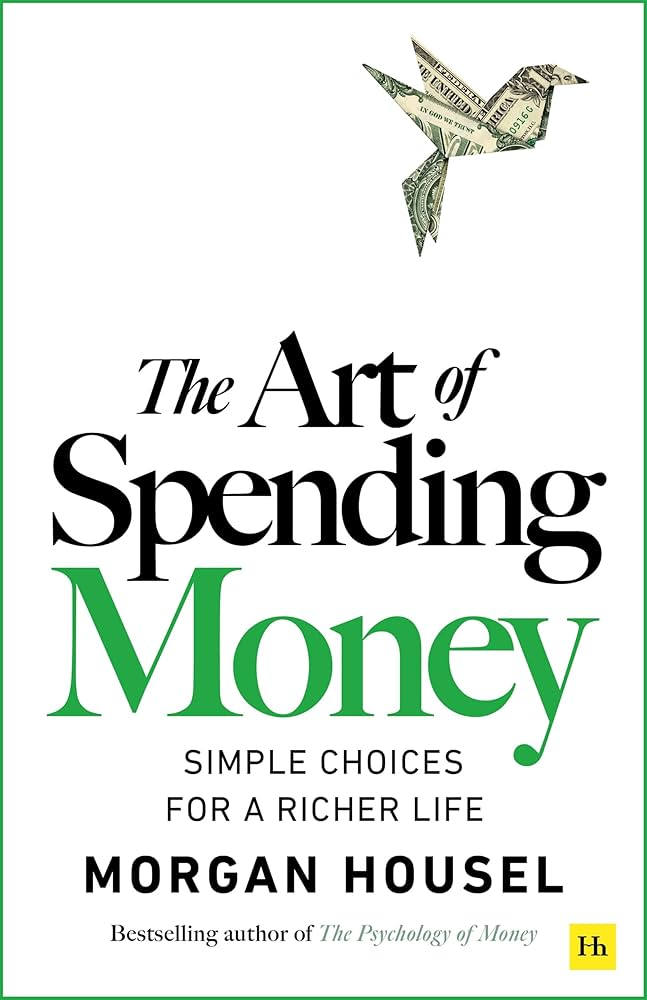
Morgan Housel, the bestselling author of The Psychology of Money, has cemented his reputation as the definitive voice in behavioral finance. His newest treatise, The Art of Spending Money: Simple Choices for a Richer Life, is not a budgeting manual; it is a profound philosophical look at the ultimate purpose of wealth. Housel argues that the greatest financial skill is not maximizing returns, but defining and deploying capital toward the things that genuinely increase life satisfaction, a concept often missed by purely mathematical financial advice.
The Tyranny of the Unexamined Purchase
The central revelation of this book is that spending is fundamentally about trading money for utility, and that utility is entirely subjective. Housel masterfully dissects the common fallacy: we budget for costs but rarely for feelings. The book pushes readers to calculate the true, often hidden, costs of their purchases, arguing that the most expensive items are rarely listed on a price tag.
The true cost of a $50,000 sports car is not the money, but the time spent earning it, the stress maintaining it, and the lost freedom that comes from being locked into an elevated lifestyle. Housel introduces the concept of “buying time.” Spending money to delegate tasks (cleaning, grocery delivery, childcare) or reduce commute times is often the single best investment one can make, as it directly increases the most finite resource we possess: personal autonomy.
“The highest form of wealth is the ability to wake up every morning and say, ‘I can do whatever I want today.’ The money spent to achieve that is the most rational spending of all.”
Status vs. Substance: The Zero-Sum Game of Showing Off
Housel dedicates significant pages to the psychological trap of aspirational spending. In a world saturated with social media and external benchmarks, he warns that money spent on status—the desire to show others how much we have—is a zero-sum game of diminishing returns.
He points out the irony: the money spent to project wealth often achieves the opposite. It rarely impresses the people you want it to, and worse, it ties you to an endless treadmill of escalating expenditures designed to maintain a facade. The money that truly buys a richer life is the money spent internally, on experiences, health, rest, and learning. These are the assets that compound happiness without relying on external validation. The book is a forceful reminder that true wealth is hidden; true richness is loud.
Simple Choices, Compounding Effects
The “Simple Choices” promised in the subtitle are not five-step plans but five foundational mindsets that compound over decades:
- Know Your ‘Enough’: Defining the boundary where money switches from being a tool for freedom to a burden of complexity.
- Spend on Friction Removal: Prioritize purchases that eliminate tedious chores, time sinks, and minor daily stressors. These “anti-anxiety” investments pay daily dividends.
- The Budget of Imperfection: Accept that spending on things you love, even if seemingly irrational (e.g., an expensive hobby), is vital for sustainability. A perfect budget is one you quit; an imperfect one is one you keep.
- Save for Optionality: The goal of saving is less about retirement and more about creating “optionality”—the ability to walk away from a bad job, handle an emergency, or seize an unexpected opportunity.
Conclusion: A Behavioral Blueprint for Life’s Budget
The Art of Spending Money serves as the perfect companion piece to Housel’s earlier work. While The Psychology of Money explained why we behave irrationally with saving and investing, this book explains how to apply rationality to consumption.
It is a necessary, introspective read for anyone who has achieved financial success only to find themselves no happier than before. It’s a book that doesn’t just ask, “How much did this cost?” but the far more important question: “What did this buy me in terms of time, peace, or joy?” By recalibrating our spending from a focus on possessions to a focus on personal utility, Housel provides the blueprint for living a truly, and sustainably, richer life.
About The Author