Temporal Tangle: Reviewing Rajavel’s Genre-Bending House Mates
⭐⭐⭐ 3/5
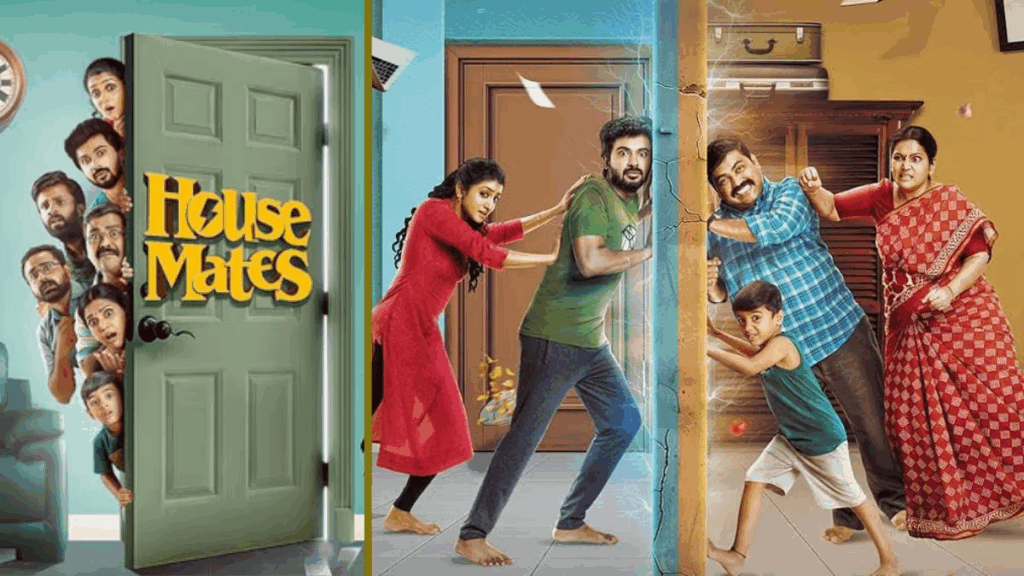
Debut director Rajavel takes a significant conceptual swing with House Mates, a film that refuses to be constrained by a single genre. Marketed initially as a conventional horror-comedy, the film quickly evolves into a unique, emotionally-charged fantasy that uses the claustrophobic setting of a single apartment to explore themes of loss, time, and inadvertent connection. While the ambition occasionally outstrips the execution, House Mates is a refreshing and largely successful experiment in Tamil cinema.
The Haunting of the Tesseract
The premise begins with newlywed couple Karthik (Darshan) and Anu (Aarsha Chandini Baiju) moving into a second-hand apartment, only to be immediately greeted by classic paranormal disturbances—flickering lights, moving objects, and eerie sounds. Just as the audience settles in for a standard haunted house trope, Rajavel pulls a clever pivot. The haunting is not caused by a malicious spirit, but by a temporal anomaly—a “tesseract”—that causes the apartment to exist simultaneously across two distinct timelines (2012 and 2022), leading to an unintentional time-share with the apartment’s previous tenants.
This core twist is the film’s greatest strength, allowing it to move beyond cheap jump-scares and into the territory of sci-fi comedy. The initial interactions between the two families—who communicate via wall scribbles and unknowingly affect each other’s domestic lives—provide the film’s funniest and most original sequences, grounding the high-concept physics in relatable middle-class chaos.
Balancing Comedy, Sci-Fi, and Sentiment
House Mates truly shines when it leans into the emotional weight of its premise. Kaali Venkat, playing Ramesh, the father in the 2012 timeline, delivers a standout performance that anchors the narrative. His storyline, concerning the fate of his young son, provides the film with the necessary emotional gravity to accept the more ludicrous aspects of the time-bending logic.
However, the film often struggles with tonal consistency. The shifts from light-hearted marital comedy to chilling horror and then to dense sci-fi exposition are occasionally jarring. The segments dedicated to explaining the temporal mechanics sometimes slow the pace and rely too heavily on jargon, pushing the audience out of the emotional reality of the characters. Furthermore, while the enclosed setting highlights the tension, the cinematography can feel visually monotonous, failing to fully leverage the creative potential of two timelines occupying the same space.
Performance and Payoff
Aarsha Chandini Baiju, in her debut, is impressive as Anu, convincingly portraying both fear and humor. Darshan, while sincere as Karthik, struggles to match the emotional depth brought by the veterans, particularly in the film’s climax. The film’s strength truly lies in its ensemble, with the parallel track carried beautifully by Kaali Venkat and Vinodhini Vaidyanathan.
The final act successfully steers away from formulaic resolutions, opting instead for a surprisingly cathartic and sentimental conclusion. By focusing on how the two families help each other achieve emotional closure across the temporal divide, Rajavel delivers a resonant message about connection and support that elevates House Mates beyond its technical flaws.
Final Verdict
House Mates is an inventive and courageous debut that injects genuine heart into the crowded horror-comedy genre. While a tighter screenplay and more streamlined approach to the sci-fi elements would have propelled it toward perfection, its original concept and the strong, emotionally resonant performances—especially by Kaali Venkat—make it a worthwhile and engaging watch. It is a film that promises a haunted house but delivers a house full of time-traveling tenants, proving that sometimes, a bold idea is more powerful than a big budget.
About The Author