
The Invisible Traps of the Mind: A Review of Rolf Dobelli’s “The Art of Thinking Clearly”
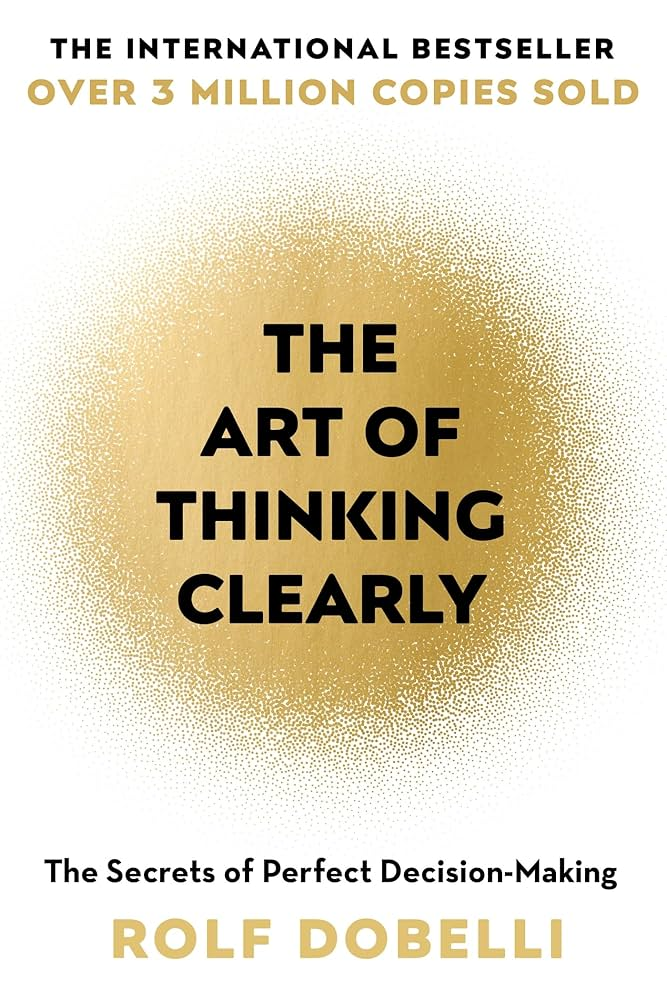
Rolf Dobelli’s “The Art of Thinking Clearly” serves as a compelling and accessible guide to navigating the myriad cognitive biases and logical fallacies that often cloud our judgment and lead to suboptimal decisions. Far from being a dense academic tome, the book presents its insights in a series of concise, digestible chapters, each dedicated to a specific “thinking error.” Dobelli’s strength lies in his ability to distill complex psychological phenomena into relatable anecdotes and simple explanations, making the often-invisible workings of our minds strikingly apparent.
Unpacking Our Brain’s Flaws
The book’s central premise is that our brains, while marvels of evolution, are also riddled with inherent flaws – shortcuts and predispositions that, while sometimes efficient, frequently lead us astray. Dobelli meticulously unpacks over fifty such errors, ranging from the familiar Confirmation Bias (our tendency to seek out information that confirms existing beliefs) and Availability Bias (overestimating the likelihood of events that are easily recalled) to the more nuanced Sunk Cost Fallacy (persisting in an endeavor due to resources already invested) and Survivorship Bias (focusing on successful outcomes while ignoring failures).
From Theory to Real-World Impact
What makes “The Art of Thinking Clearly” particularly impactful is its practical orientation. Dobelli doesn’t just describe these biases; he illustrates their real-world consequences, often drawing examples from business, finance, and everyday life. He shows how these cognitive traps can lead to poor investment decisions, flawed hiring choices, and even misguided personal goals. By shedding light on these common pitfalls, the book empowers readers to recognize them in their own thinking and, crucially, in the thinking of others.
Cultivating Deliberate Decision-Making
While not offering a magic bullet for perfect rationality, Dobelli’s work advocates for a more conscious and deliberate approach to decision-making. He encourages readers to cultivate a healthy skepticism, to question their initial impulses, and to actively seek out disconfirming evidence. The book acts as a mental toolkit, providing frameworks and heuristics to challenge assumptions and to approach problems with greater clarity. For instance, understanding the Illusion of Control can help us avoid taking unnecessary risks, just as recognizing the Social Proof bias can prevent us from blindly following the crowd.
A Practical Guide to Clearer Thinking
However, the book’s format, while accessible, can also be its minor drawback. The rapid-fire presentation of biases, while engaging, might sometimes feel like a checklist, potentially sacrificing deeper exploration for breadth. Yet, this very structure also makes it an excellent reference book, allowing readers to dip in and out, refreshing their understanding of specific biases as needed.
Conclusion: A Roadmap for Rationality
In conclusion, “The Art of Thinking Clearly” is an essential read for anyone seeking to improve their decision-making and gain a deeper understanding of human psychology. Dobelli’s clear, concise, and often humorous prose demystifies the complex landscape of cognitive biases, offering actionable insights that can be immediately applied. By making us aware of the subtle yet powerful forces that shape our thoughts, the book provides a valuable roadmap for navigating the complexities of the modern world with greater rationality and, ultimately, greater success. It’s a powerful reminder that thinking clearly isn’t just an innate ability, but a skill that can be honed and refined through awareness and deliberate practice.
About The Author