
In Search of Lost Time: A Journey Through Memory’s Labyrinth
⭐⭐⭐⭐⭐ (5/5)
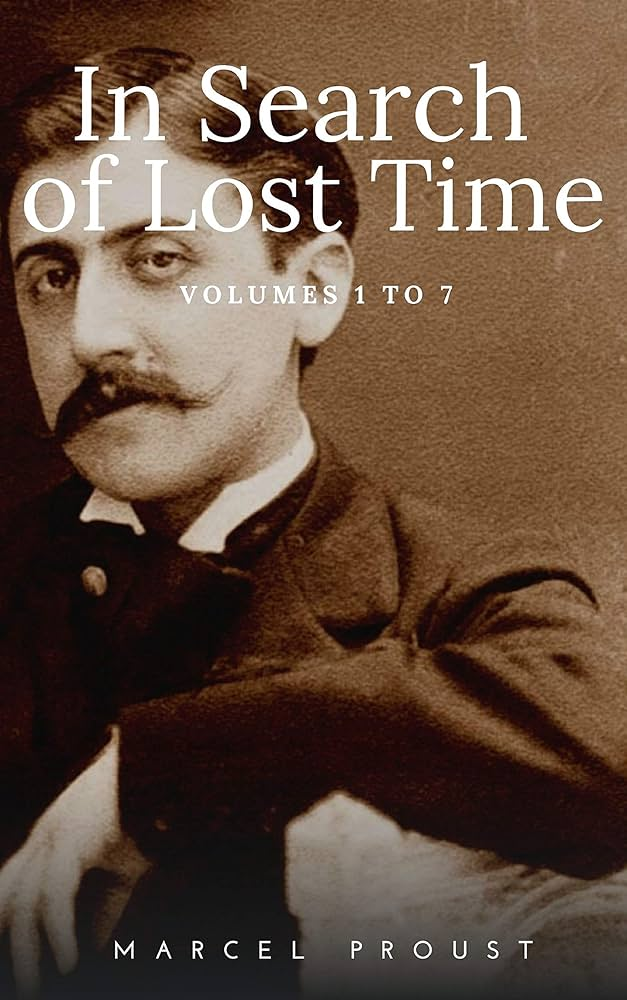
Marcel Proust’s monumental work, “In Search of Lost Time” (also known as “Remembrance of Things Past”), is not merely a novel; it is an immersive expedition into the deepest recesses of human memory, consciousness, and the elusive nature of time itself. Spanning seven volumes and thousands of pages, Proust’s masterpiece, published between 1913 and 1927, invites readers into a richly detailed world where a madeleine dipped in tea can unlock torrents of forgotten sensations, emotions, and experiences.
The Architect of Memory
At its heart, “In Search of Lost Time” is the narrator Marcel’s quest to recover his past and understand the meaning of his existence through involuntary memory. Proust’s revolutionary approach to narration shatters traditional plot structures, instead focusing on the intricate web of associations, feelings, and perceptions that constitute inner life. The famous madeleine incident, early in the first volume, “Swann’s Way,” is a perfect illustration. A simple taste triggers a cascade of vivid childhood recollections, proving that memory is not a static record but a living, breathing entity.
Proust meticulously dissects the mechanisms of memory—how smells, sounds, and tastes can transport us instantly to another time, bypassing conscious effort. He shows us how these “involuntary memories” often hold more truth and emotional weight than our deliberate attempts to recall events.
A Tapestry of Society and Self
Beyond its profound exploration of memory, “In Search of Lost Time” offers an unparalleled portrait of French society at the turn of the 20th century. Proust paints vivid frescoes of the Parisian salons, the aristocratic circles, and the burgeoning middle class, exposing their snobberies, their desires, and their often-unspoken rules. Characters like Charles Swann, Odette de Crécy, and the Baron de Charlus are rendered with extraordinary psychological depth, their lives intertwining in a complex dance of love, jealousy, and social maneuvering.
Each character, no matter how minor, contributes to the vast, intricate tapestry that is Proust’s world. Through their interactions, we witness the subtle shifts in social status, the fleeting nature of passion, and the often-disappointing reality of human relationships.
The Elusive Nature of Time
Proust’s magnum opus is, fundamentally, a meditation on time. He explores how time shapes our perceptions, erodes our memories, and ultimately dictates our destiny. The narrator’s realization that true understanding and artistic creation can only come from synthesizing these scattered fragments of the past into a coherent whole is the novel’s ultimate revelation. Time is not lost, but rather, preserved within us, waiting to be rediscovered and transformed into art.
“In Search of Lost Time” demands patience and immersion, but the rewards are immeasurable. It is a work that challenges, enchants, and ultimately transforms the reader’s understanding of self, memory, and the very fabric of existence. Dive into Proust’s world, and you may just find yourself embarking on your own profound journey of introspection.
About The Author