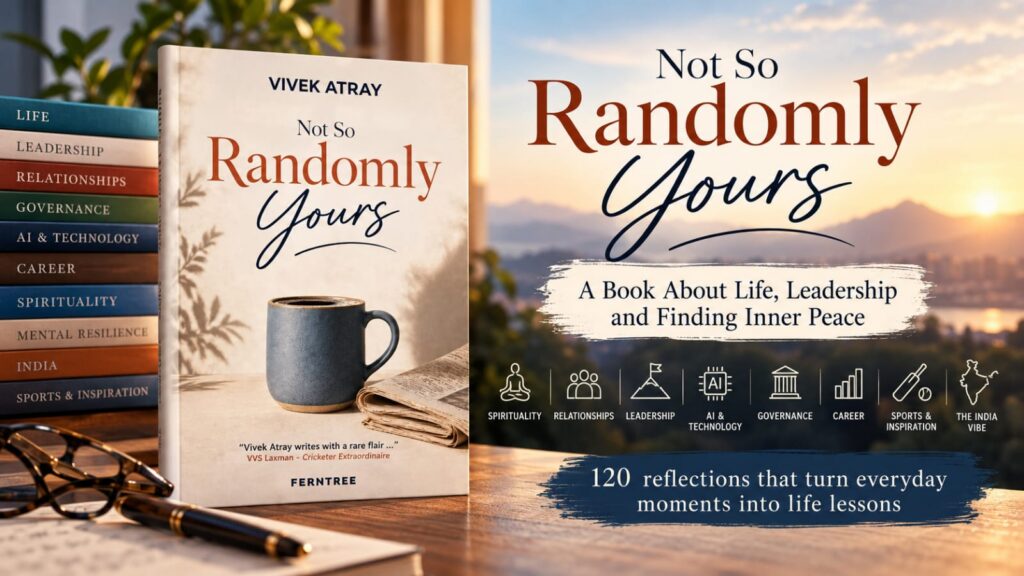
Not So Randomly Yours: When Everyday Observations Become Lessons for Life
Amazon Book Link – https://amzn.in/d/05CQwU7R
Book Rating – 5/5
A reflection on Vivek Atray’s latest collection of writings on leadership, relationships, inner peace, governance and the everyday experiences that quietly shape us
There are books that demand to be finished quickly, and there are books that invite us to stop.
To think.
To revisit something we believed we already understood.
Vivek Atray’s Not So Randomly Yours belongs firmly to the latter category.
At first glance, the book appears to be an eclectic collection of observations. Governance can sit alongside relationships; artificial intelligence can find space beside spirituality; leadership may be followed by humour or an observation drawn from something utterly ordinary.
Yet, as the pages accumulate, the apparent randomness begins to disappear.
A common thread emerges: how do we live intelligently, meaningfully and peacefully in a world that increasingly rewards speed over reflection?
That question quietly gives the book its character.
Published by Ferntree Publishing, Not So Randomly Yours brings together 120 writings from Atray’s widely read Random Forays column, written over roughly five years. The pieces span subjects ranging from governance, relationships and spirituality to sports, leadership, artificial intelligence and the quirks of contemporary life.
And perhaps that is precisely why the title works so well.
The subjects may seem random.
The philosophy behind them is not.
A Book Built from Life Rather Than Theory
Vivek Atray has spent years moving through very different worlds—as a former civil servant, author, columnist, motivational speaker, administrator, mentor and observer of people.
That breadth is visible in the book.
But Not So Randomly Yours does not read like a conventional management manual or a collection of abstract philosophical arguments. Its strength lies in something considerably simpler: observation.
Everyday incidents become starting points for larger questions.
What does good leadership actually look like?
Why do relationships deteriorate despite constant connectivity?
How much of our unhappiness comes from overthinking?
What happens when authority is confused with leadership?
How should technology coexist with humanity?
And, ultimately, what does success mean when professional achievement does not necessarily produce inner peace?
Atray has described his intention as raising perspective rather than preaching, using accessible essays to encourage readers to think differently about ordinary life.
That distinction matters.
The reader is rarely made to feel that a lesson is being imposed. Instead, an incident is placed before us and we are allowed to arrive at the lesson ourselves.
The Ten Worlds Inside One Book
The diversity of Not So Randomly Yours is substantial.
Atray groups its 120 writings around ten areas: Spirituality, Humour, AI Times, The Battle of the Mind, Relationships, Good Governance, Leadership, Sports & Inspiration, Career Goals, and The India Vibe.
It would be easy for such a broad canvas to feel disconnected.
Instead, its breadth becomes one of the book’s advantages because modern life itself is not divided into neat compartments.
The person making decisions in an office is also navigating relationships at home. The administrator concerned with governance is also confronting stress and uncertainty. The young professional thinking about artificial intelligence is simultaneously thinking about career security, identity and purpose.
Not So Randomly Yours recognises these overlaps.
It treats the reader not merely as a professional, parent, student, leader or citizen—but as a human being occupying several roles at once.
Leadership Without the Noise
Among the book’s strongest recurring themes is leadership.
Contemporary discussions about leadership often revolve around visibility, influence, authority and performance. Atray repeatedly draws attention to quieter qualities: empathy, humility, emotional intelligence, responsibility and the ability to bring people together.
That perspective carries particular weight because it is informed by years of public administration rather than management theory alone.
The book repeatedly suggests that holding authority and exercising leadership are not necessarily the same thing.
Real leadership becomes visible in how people behave when circumstances are difficult, when disagreements arise and when there is no applause for doing the right thing.
This makes the book particularly relevant not only for senior executives or administrators, but also for young professionals, educators, entrepreneurs and students beginning to understand what responsibility actually entails.
The Battle Is Often Within
Another important dimension of the book is what Atray calls “The Battle of the Mind.”
We live in an era of extraordinary external connectivity and equally extraordinary internal distraction.
Screens compete for attention. Comparison has become instantaneous. Professional pressure follows people home. Information arrives faster than the mind can meaningfully process it.
Against this background, Atray repeatedly returns to ideas such as reducing overthinking, limiting excessive screen time, strengthening family relationships, cultivating mental toughness and seeking inner peace. His public remarks around the book have similarly emphasized that success cannot be understood purely through external achievement.
It is an important counterpoint to today’s productivity culture.
Sometimes progress does not require doing more.
Sometimes it requires thinking more clearly about what deserves to be done at all.
Relationships, Words and the Lost Art of Pausing
Some of the most relatable observations in Not So Randomly Yours concern human relationships.
Relationships rarely collapse because people lack access to information. More often, they suffer from ego, impatience, assumptions, careless communication and an unwillingness to listen.
Here, Atray’s conversational style becomes particularly effective.
Rather than offering formulas for relationships, the writings encourage something increasingly uncommon: pause before reaction.
Words matter.
Tone matters.
Patience matters.
And the ability to disagree without destroying a relationship matters enormously.
In an age where public discourse and private conversations can become reactive within seconds, these seemingly elementary ideas acquire renewed importance.
Governance Is Ultimately About People
Atray’s administrative experience also gives the writings on governance a distinctive texture.
Good governance, in this telling, cannot be reduced simply to policies, files or technology. Institutions ultimately operate through people.
During the launch of the book, Atray spoke about the importance of good officers and institutional memory within administrative systems.
That observation points toward a broader lesson extending beyond government.
Institutions become stronger when knowledge survives individuals.
Organisations become healthier when systems complement personalities.
And leadership becomes sustainable when responsibility is distributed rather than concentrated.
These principles are as relevant to governments as they are to companies, universities, social organisations and startups.
Technology Changes. Human Questions Remain.
The inclusion of AI Times makes the collection distinctly contemporary.
Artificial intelligence is transforming how people learn, work, communicate and make decisions. But technological advancement simultaneously raises a more fundamental question:
What should remain uniquely human?
Judgment.
Empathy.
Curiosity.
Character.
Wisdom.
The ability to understand context.
Technology may dramatically expand human capability, but capability without perspective is not necessarily progress.
By placing AI alongside spirituality, relationships, governance and mental resilience, the book implicitly reminds us that the future cannot be understood through technology alone.
The future remains a human question.
From Cricket and Icons to Everyday Inspiration
The book also finds lessons in sport, personalities and familiar cultural experiences.
That ability to move comfortably between serious questions and lighter observations prevents the collection from becoming heavy.
One moment may invite reflection on leadership; another may emerge from cricket, music, popular culture or an everyday irritation.
This approach mirrors how wisdom usually enters our lives.
Rarely through grand announcements.
More often through ordinary moments that suddenly reveal something larger.
Why the Short-Essay Format Works
One of the most practical strengths of Not So Randomly Yours is its format.
Readers do not necessarily need to approach its hundreds of pages sequentially.
An essay can be read during a morning coffee, between meetings, during travel or before going to sleep.
Yet brevity does not necessarily mean superficiality.
A short piece can remain in the mind for hours.
That quality makes this collection especially suited to an age of diminishing attention spans. Goodreads currently lists the hardcover at 463 pages, but because it comprises independent writings, it can function almost as a book of intellectual pauses rather than a continuous narrative.
You can read ten pages.
Or two.
And still leave with something worth thinking about.
The Deeper Meaning of “Not So Randomly Yours”
Perhaps the most interesting interpretation of the title becomes visible only after spending time with the collection.
Life itself often feels random.
A conversation.
A setback.
A colleague.
A newspaper headline.
A family disagreement.
A cricket match.
A bureaucratic experience.
A technological disruption.
A moment of silence.
Individually, these experiences may appear unrelated.
But thoughtful observation connects them.
That is essentially what Atray does throughout the book: he searches for patterns inside apparently ordinary experiences.
And in doing so, he reminds us that wisdom does not always arrive through extraordinary circumstances.
Sometimes it has been sitting inside everyday life all along.
We simply failed to notice it.
About Vivek Atray
Vivek Atray is a former IAS officer, author, columnist and motivational speaker whose professional journey has traversed administration, technology, tourism, education, public communication, writing and mentoring. His Random Forays column has run for more than a decade, and Not So Randomly Yours is his sixth book.
His administrative career included roles connected with IT, tourism, industries, technical education and public relations, and he has remained closely associated with cricket as well.
That diversity of experience helps explain why his writing moves so naturally between administration and spirituality, cricket and careers, technology and relationships.
A Book to Return To
The lasting appeal of Not So Randomly Yours may ultimately lie not in any single essay but in the worldview connecting them.
Be ambitious but preserve perspective.
Lead but remain empathetic.
Embrace technology but protect your humanity.
Work hard but do not allow achievement to consume relationships.
Speak but know when silence is wiser.
Move forward but occasionally pause long enough to understand where you are going.
These are not revolutionary ideas.
Perhaps they do not need to be.
Some of the most valuable truths are timeless precisely because every generation has to rediscover them for itself.
Not So Randomly Yours gives readers 120 opportunities to do exactly that.
It is a book that can sit beside the bed, on an office desk or in a travel bag, not necessarily waiting to be read from beginning to end, but waiting to be opened whenever life itself demands a little perspective.
And perhaps that is the most appropriate description of Vivek Atray’s collection:
not merely a book of essays, but a collection of pauses.
In a world perpetually asking us to hurry, that may be one of the most meaningful things a book can offer.
About The Author