When World Politics Enters Your Home
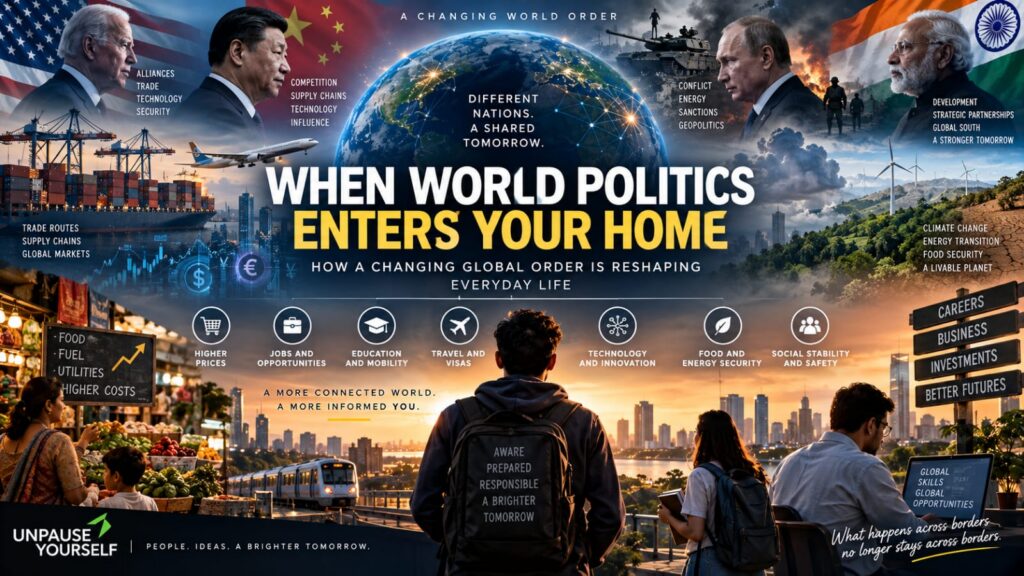
How a Changing Global Order Is Reshaping Everyday Life
Wars are fought across borders. Tariffs are announced in capitals. Sanctions are negotiated in government offices. Diplomatic alliances are discussed at international summits. Yet their consequences often arrive somewhere much closer—in our grocery bills, fuel prices, jobs, investments, education, travel plans and opportunities.
For decades, international politics appeared distant to many ordinary citizens.
Presidents met presidents. Diplomats negotiated treaties. Governments debated borders, defence and trade. International organizations produced resolutions and communiqués.
For the average person, much of this could seem like something happening elsewhere.
That distinction is becoming increasingly difficult to maintain.
In an interconnected world, geopolitics has entered everyday life.
A conflict thousands of kilometres away can influence the price of energy.
A tariff imposed by one major economy can alter the cost of a product manufactured in another.
A diplomatic disagreement can affect visas, flights, technology access or international education.
A disruption to a shipping route can eventually appear on a supermarket shelf.
And a decision about semiconductors, artificial intelligence or critical minerals can influence industries—and careers—that did not exist a generation ago.
The changing dynamics of world politics are therefore not merely a subject for diplomats.
They are increasingly part of the economics of ordinary life.
The World Is Becoming More Interconnected and More Fragmented
Globalization created extraordinary interdependence.
A smartphone may be designed in one country, use intellectual property from several others, contain minerals extracted on another continent, rely on semiconductors manufactured thousands of kilometres away and finally be assembled somewhere else entirely.
Our food, medicines, vehicles, electronics, energy systems and financial markets operate through similarly complex networks.
This interconnectedness created enormous opportunities.
But it also created vulnerabilities.
Recent years have demonstrated how wars, geopolitical tensions, tariffs and policy uncertainty can affect trade and supply chains. The World Trade Organization has warned that the global trading system is facing unusually serious and sustained disruption, while geopolitical tensions and rapid technological change are adding further complexity.
The world is consequently experiencing two forces simultaneously:
Countries still need one another, yet many are also trying to reduce their dependence on one another.
That tension may become one of the defining characteristics of the emerging global order.
The First Impact Is Often Your Wallet
For an ordinary citizen, geopolitics frequently becomes visible through prices.
Consider energy.
Oil and natural gas are globally traded commodities. Conflict or instability affecting major producing regions or transport routes can influence supply expectations and prices.
Energy costs then travel through an economy.
Higher fuel costs can increase transportation expenses.
Transportation affects the cost of moving food and manufactured goods.
Energy prices affect factories.
Factories affect production costs.
Production costs eventually influence retail prices.
The IMF’s April 2026 World Economic Outlook highlighted precisely this interconnected vulnerability, noting that conflict in the Middle East posed risks to growth and inflation and that a longer conflict, deeper geopolitical fragmentation or renewed trade tensions could weaken economic activity further.
What begins as a geopolitical development can therefore end as a household calculation:
Can I afford the same groceries, commute, electricity, holiday or monthly savings that I could before?
Tariffs Sound Technical—Until You Pay for Them
Few words in international economics sound more removed from everyday life than tariffs.
But their consequences can be remarkably personal.
A tariff is essentially a tax imposed on imported goods. Its ultimate economic burden can be distributed among exporters, importers, businesses and consumers depending on market conditions.
When tariffs increase across major trading relationships, businesses may face higher input costs, redesign supply chains, postpone investments or change where they manufacture products.
The WTO has documented how recent tariff increases and trade-policy uncertainty have affected global trade expectations and business confidence.
For citizens, those developments can eventually influence:
product prices,
availability of goods,
business investment,
export opportunities,
employment and wages,
and the competitiveness of domestic industries.
The important lesson is simple:
Trade policy does not remain at the border. It travels through the economy.
Your Job Is Connected to World Politics Too
Imagine an engineer working for an automobile manufacturer.
A software developer serving overseas clients.
A textile exporter.
A tourism professional.
A farmer dependent on imported fertilizer.
A logistics company.
A semiconductor engineer.
A student hoping to work abroad.
At first glance, these people may have little in common.
Yet each person’s economic future can be affected by international relations.
A trade agreement can open markets.
A tariff can make exports less competitive.
A conflict can interrupt supplies.
A sanction can restrict transactions.
A new bilateral relationship can create investment.
A change in immigration policy can alter access to foreign labour markets.
World politics therefore increasingly influences not only where capital moves, but where careers emerge.
This is particularly important for younger generations.
Understanding geopolitics is no longer useful only for someone studying international relations.
It is becoming a form of career literacy.
Technology Has Become Geopolitics
There was a time when technological competition was discussed primarily as competition between companies.
Increasingly, technology is also an instrument of national strategy.
Artificial intelligence, advanced semiconductors, quantum computing, cybersecurity, satellites, telecommunications, biotechnology and critical minerals now sit at the intersection of economics and national security.
Countries want access to technology.
They also want control over strategically important technologies.
That changes the nature of global competition.
The next geopolitical contest may not always concern territory.
It may concern chips, data, algorithms, computing power, energy, minerals and intellectual property.
For ordinary citizens, this can determine which technologies become available, where technology companies invest, which skills employers value and where the next generation of high-paying jobs develops.
Technology policy, industrial policy and foreign policy are increasingly overlapping.
Even Your Education Can Be Geopolitical
A student planning an international education may believe that his or her decision primarily involves choosing a university.
In reality, several geopolitical factors may intervene.
Visa policies can change.
Countries may revise post-study work rights.
Scholarships may expand or disappear.
Research collaborations can become restricted.
Currency movements can dramatically alter tuition costs.
Diplomatic relationships can affect mobility.
Governments may compete to attract researchers and highly skilled professionals.
This means that international education is not isolated from politics either.
For millions of students and families, a diplomatic or immigration-policy announcement can alter years of planning.
Borders Matter Again—but So Do Global Networks
The early decades of globalization created an expectation that borders would gradually become less important economically.
Today’s reality is more complicated.
Governments are increasingly thinking about supply-chain security, strategic industries, domestic manufacturing and national resilience.
Terms such as friend-shoring, near-shoring, strategic autonomy and supply-chain diversification have entered economic discussions.
Companies are asking questions they once asked less frequently:
Where should we manufacture?
Which countries are politically stable?
Could sanctions interrupt this supplier?
Could a shipping route become unavailable?
Should production be distributed across several countries?
The geography of business is consequently changing.
And whenever companies change where they invest and manufacture, employment opportunities eventually change with them.
Conflict Has a Human Cost Beyond Economics
Not every consequence of geopolitical instability can—or should—be measured in money.
Behind discussions of war and international security are human beings.
According to UNHCR, approximately 117.8 million people were forcibly displaced worldwide at the end of 2025 because of persecution, conflict, violence, human-rights violations or events seriously disturbing public order.
That number represents more than a statistic.
It represents families leaving homes.
Children losing classrooms.
Professionals abandoning careers.
Communities being separated.
People rebuilding lives in unfamiliar countries.
For someone living safely thousands of kilometres away, geopolitical conflict may appear as a headline.
For someone caught inside it, geopolitics can determine whether there is a home to return to.
That distinction should never disappear from conversations about international affairs.
Climate Change Is Also Changing International Politics
Another transformation is occurring quietly alongside traditional geopolitical competition.
Climate change is altering how countries think about energy, food, water, migration and economic security.
The transition towards renewable energy creates new opportunities but also new strategic dependencies.
Countries that once competed heavily over oil may increasingly compete over lithium, cobalt, nickel, copper, rare-earth elements, battery manufacturing and clean-energy technologies.
Water scarcity and extreme weather can intensify existing social and economic pressures.
Food security can become a diplomatic concern.
Climate migration can place pressure on cities and borders.
The politics of the twenty-first century will therefore not simply be about who controls territory.
It will increasingly concern who possesses resources, technology, resilience and adaptability.
The Rise of a More Multipolar World
Another significant transformation is the diffusion of economic and political influence across a wider range of countries.
The international system is increasingly shaped not only by established powers but also by emerging economies and regional groupings seeking greater influence over trade, finance, technology, energy and global governance.
For citizens, multipolarity can create both opportunities and uncertainties.
Businesses may gain access to new markets.
Students may discover new education destinations.
Countries may attract investment from multiple partners.
New transport and trade corridors may emerge.
But greater strategic competition can also make international rules and economic relationships more complicated.
The emerging world may therefore be neither completely globalized nor completely fragmented.
It may be selectively interconnected.
Countries will cooperate where interests converge and compete where they do not.
Social Media Has Brought Foreign Policy Into Our Pockets
There is another major difference between today’s geopolitical environment and that of previous generations.
We experience international events almost instantly.
A speech delivered thousands of kilometres away can appear on a smartphone within seconds.
Videos from a conflict zone circulate globally before governments have issued official statements.
Citizens watch diplomacy unfold in real time.
This democratization of information can increase awareness.
But it carries another challenge:
information is not the same as understanding.
The same platforms that provide unprecedented access to world events can distribute misinformation, manipulated media, propaganda and emotionally charged narratives.
Artificial intelligence makes this challenge even more complex.
The modern citizen therefore requires something beyond access to information.
We need the ability to verify, contextualize and think critically.
In an age of information abundance, judgement becomes a civic skill.
What Should the Common Citizen Do?
No individual can control global politics.
But individuals can become more resilient to its consequences.
Financial literacy matters when inflation, interest rates and currencies fluctuate.
Digital literacy matters when misinformation spreads.
Continuous learning matters when technological competition transforms industries.
Understanding international developments matters when careers and businesses operate globally.
Diversification matters for entrepreneurs dependent on one supplier or market.
And dialogue matters in societies where geopolitical disagreements can quickly become polarized domestic conversations.
The objective is not for every citizen to become a geopolitical analyst.
It is to understand that global awareness has become part of personal preparedness.
Cooperation Still Matters
The language surrounding international affairs increasingly emphasizes competition.
But almost every major challenge confronting humanity also requires cooperation.
Climate change cannot be solved within one border.
Pandemics do not require passports.
Financial crises can travel rapidly across markets.
Cyber threats operate internationally.
Artificial intelligence will raise questions that no single country can answer entirely on its own.
International trade depends on predictable rules.
And global development requires knowledge, capital and institutions to work across borders.
The international system may be changing, but interdependence has not disappeared.
The challenge is therefore not choosing between national interests and international cooperation.
It is finding frameworks in which legitimate national interests can coexist with a world that remains fundamentally interconnected.
The Unpause Perspective: Think Globally, Prepare Personally
At Unpause Yourself, we often speak about careers, entrepreneurship, education, innovation and human potential.
Increasingly, none of these subjects can be understood without looking beyond national borders.
The entrepreneur of tomorrow must understand global markets.
The professional must understand technological shifts.
The student must understand international opportunities.
The investor must understand global risk.
And the responsible citizen must learn to distinguish information from manipulation and disagreement from hostility.
World politics may appear to belong to presidents, prime ministers, diplomats and international institutions.
But its consequences belong to everyone.
They reach the fuel station.
The supermarket.
The university.
The workplace.
The stock market.
The airport.
And eventually, the family dining table.
Perhaps that is the defining lesson of our interconnected century:
There is increasingly no such thing as a distant event.
A decision made somewhere in the world can eventually become a price, an opportunity, a risk or a choice somewhere else.
We cannot individually determine the direction of world politics.
But we can understand it better.
We can prepare for change.
We can resist misinformation.
We can remain open to cooperation.
And above all, we can ensure that amid conversations about nations, power and strategy, we never lose sight of the people whose everyday lives ultimately bear their consequences.
Because geopolitics may shape the world.
But people have to live in it.
About The Author