
US-EU Trade Deal: A Tentative Step Towards Stabilizing Transatlantic Commerce
Brussels/Washington – The United States and the European Union on Thursday released a framework trade deal, a pivotal, albeit “bare-bones,” agreement aimed at stabilizing their significant transatlantic commercial relationship. While hailed by some as a crucial step to avert a full-blown trade war, the pact introduces a 15% import tax on 70% of European goods exported to the U.S., a notable increase from pre-tariff levels, and leaves several contentious sectors for future negotiation. U.S. officials have indicated that auto tariff relief for European carmakers could materialize within “weeks,” contingent on legislative action from Brussels.
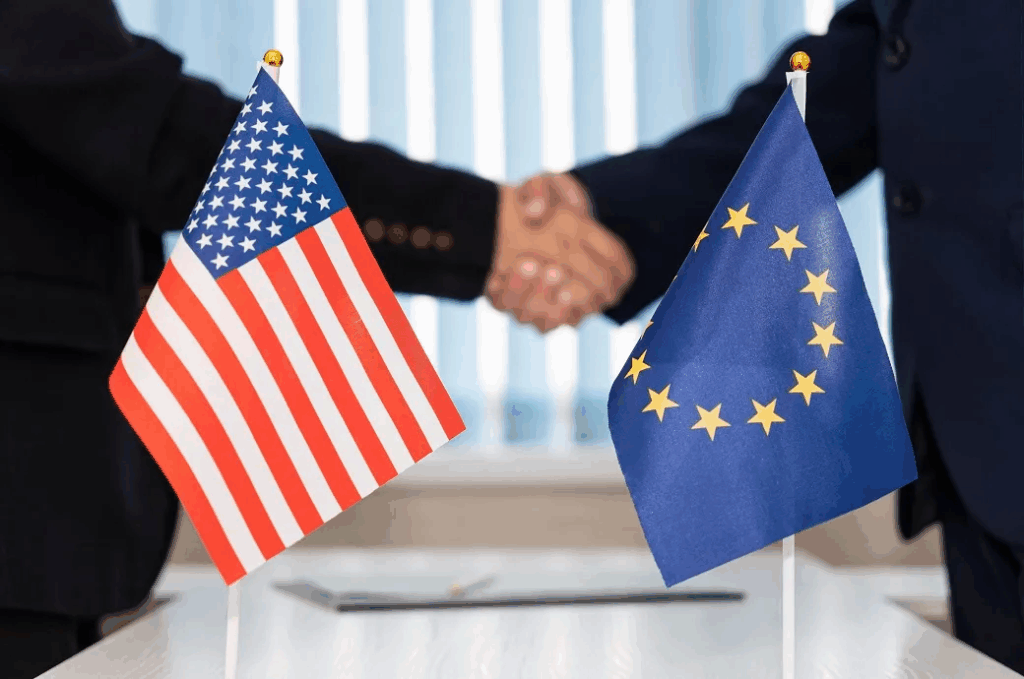
Key Provisions and Conditional Tariff Reductions
The agreement, outlined in a concise 3½-page joint statement, establishes a new tariff regime. A central component is the 15% tariff on a broad range of EU goods entering the U.S., encompassing autos, pharmaceuticals, semiconductors, and lumber. Conversely, the EU has committed to eliminating tariffs on all U.S. industrial exports and providing preferential market access for various U.S. agricultural and seafood products.
Crucially, the reduction of the current 27.5% U.S. tariffs on European cars and car parts to the baseline 15% is contingent upon the EU formally introducing legislation to enact its promised tariff cuts on U.S. goods. U.S. officials are pressing for swift legislative action from Brussels, suggesting that tariff relief for European automakers could be retroactive to August 1 if the EU introduces the necessary legislation this month.
Certain strategic products, including aircraft and aircraft parts, generic pharmaceuticals, and specific natural resources (like cork), will revert to Most Favored Nation (MFN) tariffs as of September 1, offering immediate relief in these sectors.
Unresolved Issues and Industry Reactions
Despite the framework, several critical areas remain unresolved, notably wine and spirits, and steel and aluminum. These sectors will be subject to continued talks, much to the dismay of industries on both sides of the Atlantic. The Distilled Spirits Council of the United States, for instance, criticized the exclusion of wine and spirits from immediate exemptions, warning of substantial retail losses and job impacts if a permanent zero-for-zero tariff regime isn’t established.
The deal has garnered mixed reactions. While European Commission President Ursula von der Leyen defended it as a necessary measure to prevent higher tariffs and as a foundation for further negotiations, some EU businesses and member governments expressed concern, arguing that the bloc may have conceded too much. The European Automobile Manufacturers’ Association (ACEA) welcomed the clarity on auto tariffs but stressed the urgency for the EU to implement its commitments to mitigate the ongoing financial impact on automakers.
Broader Commitments and Economic Implications
Beyond tariffs, the framework includes non-binding commitments. The EU intends to procure $750 billion in U.S. energy products (including liquefied natural gas, oil, and nuclear energy) through 2028, and EU companies aim to invest $600 billion in the U.S. economy over the next three years. These commitments underscore a broader objective of strengthening economic security alignment, enhancing supply chain resilience, and addressing non-market policies of third parties.
Economists caution that the imposition of higher tariffs, even if below the previously threatened levels, could lead to slower economic growth and higher consumer prices. The success of this “first step” will heavily depend on the diligence of subsequent negotiations and the political will on both sides to address the remaining complexities and implement the agreed-upon terms effectively. The framework represents a delicate balance, aiming to foster stability while acknowledging the significant shifts in global trade dynamics.
About The Author