The Sirens’ Call: Reclaiming Our Most Endangered Resource
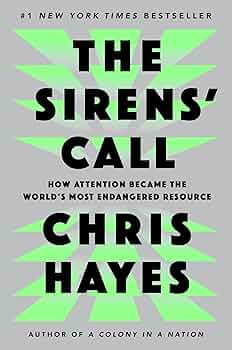
Chris Hayes’s The Sirens Call: How Attention Became the World’s Most Endangered Resource isn’t just another book lamenting our digital distractions. It’s a profound and timely exploration of how attention, once a fundamental human capacity, has been systematically transformed into a highly coveted and increasingly scarce commodity. Hayes masterfully weaves together historical context, psychological insights, and sharp social commentary to dissect the forces that have made us more distracted, fragmented, and vulnerable, even as technology promised to connect us.
The Irresistible Lure of the Digital Age
At the core of Hayes’s argument lies the potent metaphor of the siren’s call. Just as mythical sirens enchanted sailors to their doom, our smartphones, social media feeds, and constant news cycles relentlessly beckon us with promises of connection, information, and entertainment. However, Hayes exposes the underlying truth: these platforms aren’t designed to enrich our lives. Instead, they’re meticulously engineered to capture and commodify our attention. Algorithms are honed to maximize engagement, delivering dopamine hits with every notification, every “like,” and every endless scroll. This relentless pursuit of our gaze has birthed an economy where attention, once an intangible aspect of human experience, is now its most valuable resource, diligently mined, packaged, and sold to advertisers and influence peddlers.
From Scarcity to Deluge: A Historical Shift
Hayes skillfully traces the historical evolution of this crisis, illustrating how the shift from information scarcity to overwhelming abundance has fundamentally reshaped our relationship with knowledge and focus. In an era of limited news sources and slower communication, attention was naturally more concentrated. The internet’s arrival, while democratizing information, also unleashed a torrent of competing stimuli, each vying for a slice of our finite cognitive capacity. This deluge, coupled with the rise of the attention economy, has created a perpetual state of partial attention. We constantly toggle between tasks, notifications, and information streams, rarely dedicating our full focus to any single one.
Societal Ripples of a Fragmented Focus
Beyond individual distraction, Hayes powerfully articulates the societal ramifications of this attention deficit. He contends that a perpetually distracted populace is less capable of deep thought, critical analysis, and sustained civic engagement. The fragmentation of attention leads to the fragmentation of discourse, making it more challenging to build consensus, engage in nuanced debate, and collectively address complex issues. Moreover, the ceaseless barrage of information, often curated by algorithms designed to reinforce existing biases, can erode our ability to discern truth from falsehood, fostering a climate of misinformation and tribalism. In such an environment, democratic processes themselves become vulnerable, as attention is easily manipulated and diverted towards sensationalism rather than substance.
Reclaiming Our Attention: A Call to Action
Crucially, The Sirens Call isn’t solely a dystopian warning. It offers glimmers of hope and a compelling call for us to re-evaluate our relationship with technology. Hayes implicitly encourages readers to reclaim agency over their attention, advocating for intentional disengagement, mindful information consumption, and a critical awareness of the underlying mechanisms at play. While individual actions are important, the book ultimately points towards the necessity of systemic change, urging a rethinking of digital platform design principles to prioritize human well-being over relentless engagement.
Conclusion: Safeguarding the Capacity for Thought
In conclusion, Chris Hayes’s The Sirens Call serves as an urgent and essential guide for navigating the treacherous currents of the digital age. It compels us to confront the uncomfortable truth that our attention, once an intrinsic human faculty, has been transformed into a valuable, and increasingly endangered, commodity. By meticulously dissecting the forces that have led to this crisis and illuminating its far-reaching consequences, Hayes provides a vital framework for understanding the challenges we face and, more importantly, for initiating the critical conversation about how we can collectively reclaim our focus, cultivate deeper engagement, and ultimately safeguard the very capacity for thought that underpins a healthy democracy and a flourishing human experience.
About The Author