🤖 The Rise of Edge AI: Redefining Real-Time Intelligence in a Connected World
Artificial Intelligence has already transformed industries from automation in manufacturing to personalization in e-commerce. But as the digital ecosystem expands, the real disruption lies not in centralized AI clouds, but at the edge, closer to where data is born.
Welcome to the era of Edge AI where machine intelligence no longer waits for servers to respond but acts instantly, autonomously, and securely in the field.
⚙️ Understanding Edge AI
Traditionally, AI models relied on cloud computing – data collected from devices is transmitted to distant servers for processing, and results are sent back.
While powerful, this architecture introduces latency, bandwidth strain, and privacy challenges.
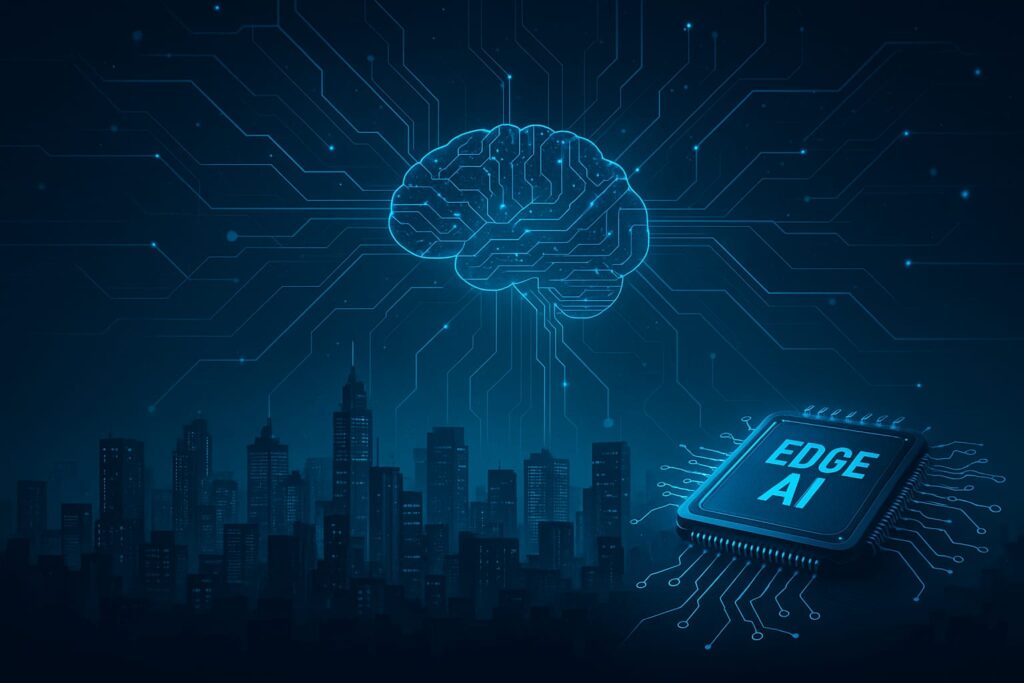
Edge AI solves this by embedding intelligence directly within local devices:
→ Cameras, sensors, wearables, vehicles, and even micro-controllers now have onboard processors capable of inference without constant cloud dependency.
This architecture enables real-time decision-making, lower energy consumption, and data privacy, ideal for applications like autonomous vehicles, healthcare monitoring, smart cities, and industrial IoT.
🧠 Core Technologies Powering Edge AI
1️⃣ TinyML (Tiny Machine Learning)
TinyML enables machine-learning models to run on ultra-low-power microcontrollers — consuming less than a milliwatt of power.
This is a game-changer for embedded systems and remote IoT devices, allowing on-site anomaly detection and pattern recognition.
2️⃣ AI Accelerators & Neural Processing Units (NPUs)
Chip manufacturers like NVIDIA, Qualcomm, Intel, and Apple are pushing boundaries with NPUs, TPUs, and AI-specific SoCs that execute complex neural networks on-device.
The result ? Lightning-fast processing for computer vision, audio recognition, and predictive maintenance without cloud dependency.
3️⃣ 5G + Edge Computing Integration
5G’s ultra-low latency synergizes perfectly with Edge AI.
Distributed computing nodes placed near telecom towers allow data from connected devices to be processed at the edge layer, reducing delays from hundreds of milliseconds to under 10 ms, critical for applications like remote surgery or autonomous fleets.
4️⃣ Federated Learning
In a privacy-sensitive world, federated learning allows multiple edge devices to collaboratively train models without exchanging raw data.
Only model updates (gradients) are shared, ensuring both accuracy and compliance with privacy frameworks such as GDPR and India’s Digital Personal Data Protection Act (DPDP 2023).
🔒 Security Implications
As AI decentralizes, the attack surface expands.
Edge devices must handle encryption, firmware integrity, and continuous monitoring to prevent adversarial tampering.
Emerging standards like Zero-Trust Architecture (ZTA) and Hardware-Root-of-Trust (HRoT) are becoming mandatory to ensure device-level AI remains trustworthy.
🌐 Applications Transforming Industries
🚗 Autonomous Mobility
Edge AI enables real-time object detection, lane recognition, and sensor fusion without external connectivity, essential for self-driving and connected vehicles.
🏭 Smart Manufacturing
Factories equipped with Edge-based sensors predict machine failure, optimize workflows, and maintain production uptime with minimal human oversight.
🏥 Healthcare
Wearables now diagnose cardiac anomalies, detect falls, and even alert doctors through local inference, reducing diagnostic latency to seconds.
🌆 Urban Infrastructure
Edge cameras in smart cities enable traffic optimization, environmental monitoring, and intelligent surveillance with immediate response mechanisms.
📊 Future of Edge AI in India
India is uniquely positioned to lead this transformation:
820+ million smartphone users provide a vast edge-device ecosystem.
5G rollouts and the upcoming India Semiconductor Mission will boost local AI hardware manufacturing.
Government policies on AI ethics, data localization, and innovation hubs are creating fertile ground for startups specializing in edge intelligence.
According to NASSCOM’s 2025 forecast, the Edge AI market in India is projected to surpass $2.4 billion by 2028, growing at a CAGR of 25 % – signaling a monumental shift from cloud dependence to hybrid-edge architectures
🧩 Challenges Ahead
Model Compression: Deploying large transformer models on constrained hardware.
Interoperability: Standardizing frameworks across edge devices and vendors.
Energy Efficiency: Balancing computational performance with power sustainability.
Skill Gap: India requires cross-trained professionals skilled in AI, embedded systems, and IoT integration.
🚀 Conclusion
Edge AI represents the next evolution of intelligent computing – fast, decentralized, and privacy-preserving.
It’s the bridge between massive data generation and meaningful real-time action.
In the coming decade, industries will not ask if they need AI — but where it should live.
And increasingly, the answer will be: at the edge.
At Nxt Unpause Yourself, we believe this shift embodies the future of innovation – blending technology, purpose, and human potential.
The edge is no longer the frontier; it’s the foundation.
About The Author