2025 Nobel Prize in Physics Honours Quantum Pioneers for Electrical Circuit Discoveries
The Royal Swedish Academy of Sciences has awarded the 2025 Nobel Prize in Physics to three distinguished scientists, John Clarke, Michel Devoret, and John Martinis, for their groundbreaking contributions to quantum mechanics. The trio is specifically recognized for their work leading to the discovery of macroscopic quantum mechanical tunneling and energy quantisation in an electric circuit, a pivotal achievement that bridged the theoretical world of quantum physics with practical, macroscopic electrical systems.
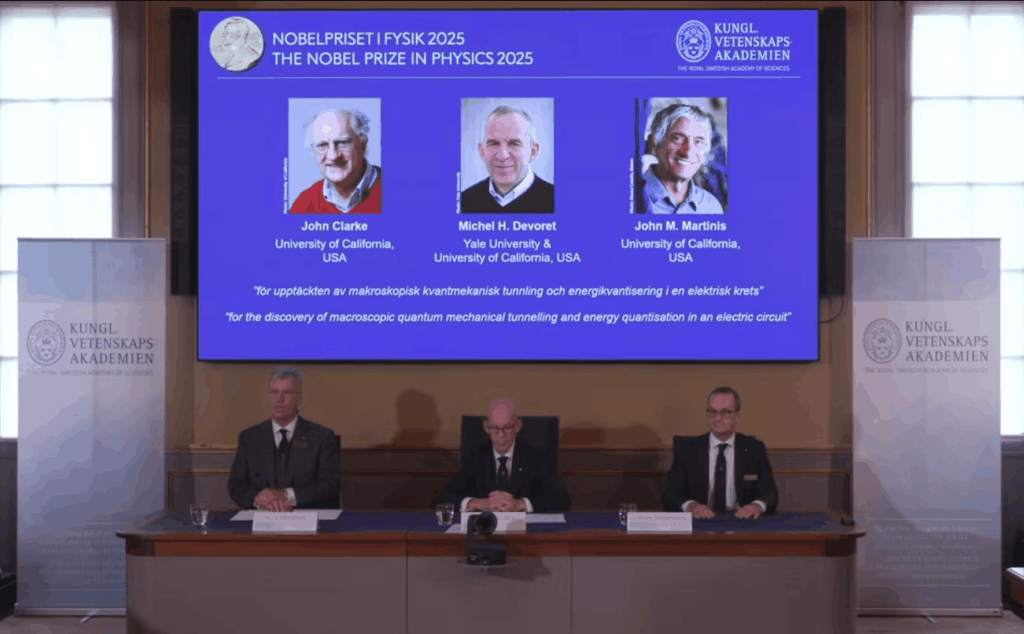
Bridging the Quantum-Classical Divide
The collective work of Clarke, Devoret, and Martinis centers on the fascinating realm of superconducting circuits ⚡. Superconductivity, the ability of certain materials to conduct electricity with zero resistance below a critical temperature, provided the perfect platform for observing purely quantum mechanical effects at a scale visible to engineers.
Their research confirmed that, even in a circuit composed of billions of electrons, the electrical properties are governed by the strange rules of quantum mechanics. Specifically, they demonstrated two key phenomena:
- Macroscopic Quantum Tunneling: This discovery showed that the collective state of the circuit’s superconducting current could “tunnel” through an energy barrier, much like a tiny quantum particle, despite the macroscopic nature of the circuit. This violated classical physics, which dictates that a system must have enough energy to overcome a barrier.
- Energy Quantisation: The scientists proved that the energy levels within these electrical circuits are not continuous, but instead exist only at discrete, quantized values, a fundamental tenet of quantum theory. This effectively means that the circuits behave like artificial atoms, with distinct energy “shells” that the electrical current can occupy.
Impact on Quantum Technology
The discoveries made by Clarke, Devoret, and Martinis have had a profound and immediate impact on the field of quantum computing. By successfully creating and controlling macroscopic quantum systems, their work laid the essential foundation for developing the superconducting qubit.
The superconducting qubit, a tiny circuit that leverages these quantum effects, is now one of the leading physical architectures for building universal quantum computers. Their insights have allowed engineers to design and manipulate these quantum bits with unprecedented precision, a critical step towards realizing devices capable of solving complex problems far beyond the reach of conventional computers.
Their research has not only deepened our fundamental understanding of quantum mechanics but has also provided the technological blueprint for the ongoing quantum revolution, making the 2025 Physics Nobel a powerful affirmation of the potential of applied quantum science.
About The Author