
Endless Repeats and Quiet Desperation: A Review of Solvej Balle’s On the Calculation of Volume
⭐⭐⭐⭐½ (4.5/5)
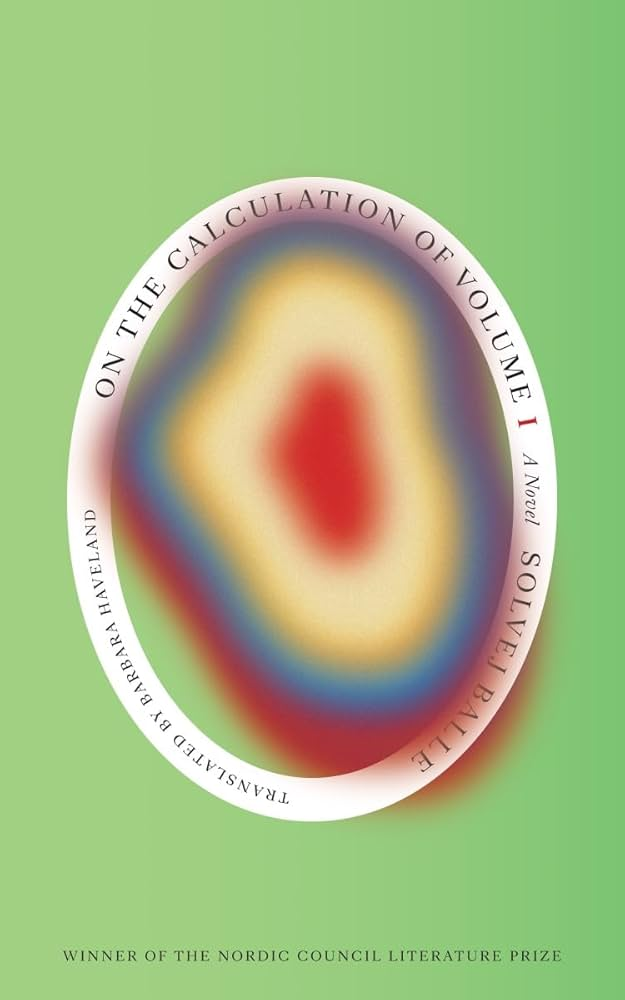
An Existential Puzzlebox
Solvej Balle’s On the Calculation of Volume: Book I is a mesmerizing and profoundly philosophical novel that plunges the reader into an existential puzzlebox. As the first installment of a planned seven-volume series, it introduces a premise both familiar and uniquely unsettling: a single day, November 18th, repeating endlessly for its protagonist, Tara Selter. While the concept of a time loop echoes popular culture, Balle eschews cinematic spectacle for a meditative, introspective examination of time, memory, and the very fabric of identity. The result is a slow-burning masterpiece of quiet desperation and profound insight.
A Ghost in Her Own Life
The narrative follows Tara, a middle-aged artist living in the French countryside, as she awakens to find herself reliving the same day. Initially, her experience is marked by a disorienting blend of confusion and detachment. She is a ghost in her own life, observing her husband, friends, and the world at large repeat their actions with robotic precision. This narrative choice allows Balle to strip away the illusion of forward momentum that defines our lives. The mundane details of each day—a bicycle courier’s delivery, the behavior of a neighbor’s dog—are elevated to objects of intense scrutiny. Tara’s journal entries, which form a core part of the text, become her only anchor to a past that no longer exists and a future that never arrives.
The Power of Precision
Balle’s prose is a testament to the power of precision. Her writing is sharp, fragmented, and almost scientific in its observation, mirroring Tara’s own detached and analytical approach to her surreal predicament. Sentences are often short, creating a rhythm that feels both staccato and deliberate. This style is not merely an aesthetic choice; it is integral to the novel’s thematic core. It forces the reader to slow down, to focus on the minutiae, and to consider the weight of each moment when moments themselves lose all meaning. The book’s title, On the Calculation of Volume, hints at this meticulous, almost mathematical exploration of a life reduced to a single, infinitely recurring point in time.
A Struggle for Meaning
As the novel progresses, Tara’s psychological journey becomes its driving force. She moves from a state of horrified paralysis to one of experimentation, attempting to break the cycle or, at the very least, find some measure of purpose within it. Her actions, ranging from subtle acts of rebellion to genuine attempts at connection, reveal a deep-seated human need for meaning and forward progress. Balle masterfully portrays the psychological toll of this existence, exploring how memory, stripped of its linear progression, becomes a fragile and distorting force. Tara’s struggle is a poignant allegory for the modern condition—the feeling of being trapped in a repetitive, unfulfilling cycle, yearning for change that seems perpetually out of reach.
A Work of Deep Contemplation
On the Calculation of Volume: Book I is not a book for those seeking a quick, plot-driven read. Instead, it is a work of deep contemplation that demands patience and rewards it with startling beauty. It is a brilliant and unsettling first volume that sets a high bar for the rest of the series. Solvej Balle has crafted a compelling meditation on existence that is at once claustrophobic and expansive, leaving the reader to ponder the true nature of time long after the final page is turned. This book is highly recommended for fans of philosophical fiction and anyone who has ever wondered what it truly means to live.
About The Author