
🌍 PM Narendra Modi Signals Call for New Global Order & Climate Summit Faces Deadlock
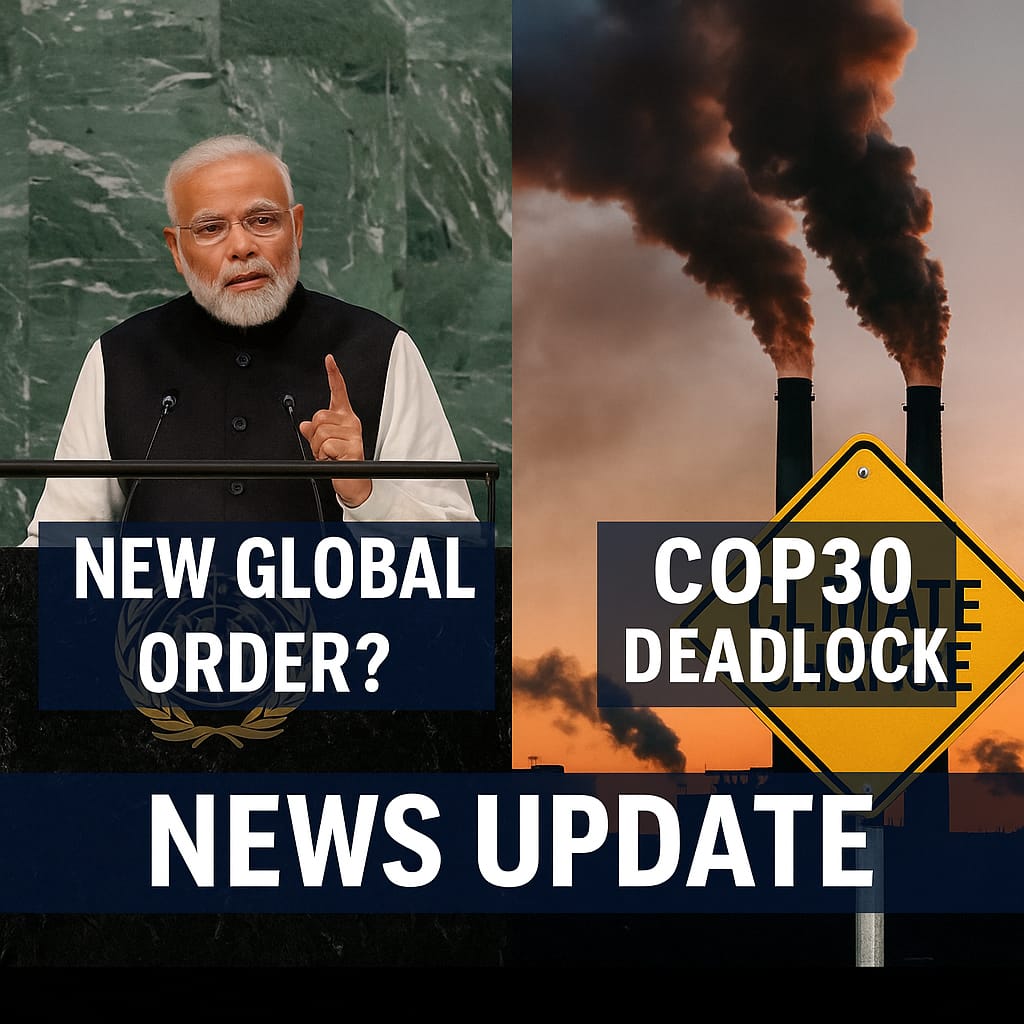
In what could be a turning point for international diplomacy, India’s defence minister asserted that the current global system needs radical reform while the COP30 climate summit has entered a critical dead-end that threatens meaningful global climate action.
🗣️ India’s Call for a “New UN and Global Order”
During the 26th International Conference of Chief Justices of the World (ICCJW) in Lucknow, defence minister Rajnath Singh declared that the United Nations “could have played a much stronger role” in recent humanitarian crises including the conflicts in Ukraine and Israel-Hamas.
Singh emphasised that today’s world demands a new structure and international order – one that is more equitable, responsive, and aligned with current geopolitical realities.
This signals a sharper stance by India on global governance and may usher a period of recalibration for multilateral institutions.
🔥 Climate Diplomacy in Crisis at COP30
Meanwhile, at the COP30 climate gathering in Belém, Brazil, negotiators from over 190 countries remain deadlocked. A key proposal to stop new fossil fuel investments was excluded from the final draft text, due to resistance by major emitters including Saudi Arabia, Russia and India.
Developing nations have voiced sharp criticism, stating that climate finance and adaptation mechanisms remain insufficient – potentially making this summit one of the most disappointing in recent memory.
📉 Why This Matters for Global Futures
Geopolitical realignment: India’s push for a new UN order may encourage other nations to seek alternative multilateral alliances or reforms.
Climate delay = Risk ahead: The failure to secure a strong fossil-fuel phase-out commitment undermines hopes of limiting warming to 1.5 °C, increasing the odds of climate shocks.
Economic & social ripple effects: Less climate progress means higher costs for adaptation, greater migration pressures, and risk of market instability.
🧭 What to Watch in The Coming Days
Will India lead or align with major reform efforts around the UN?
Will COP30 still deliver a credible package of climate finance or will it be criticised as symbolic?
How will markets, especially in vulnerable regions, respond to delayed climate commitments?
✅ Final Thought
This week’s dual developments – India advocating for a transformed international order and the COP30 summit facing severe setbacks – signal that the status-quo in global governance and climate action is under strain.
In such a landscape, those who stay informed, adaptable, and proactive will have a strategic edge.
About The Author